

Trying harder is why so many routines fail.
Sound harsh? It’s true for most of us.
Instead of an all-or-nothing plan, the routines that last are tiny, repeatable habits tied to what you already do.
This post shows a simple way to build a routine that actually sticks, starting with a no-equipment 10-minute starter you can repeat for seven days, plus habit-stacking tips and a one-week plan.
Read on to get a clear, realistic routine you can use today and keep when life gets messy.
A Simple 10‑Minute Starter Wellness Routine

A 10-minute routine works because it fits into any schedule. No overwhelm, no all-or-nothing thinking. You’re not signing up for an hour of yoga or some complicated meal plan. Just one small block of time to anchor your day.
Starting short keeps things calm. Your nervous system doesn’t panic. You can repeat it without overthinking.
Here’s what you can start today:
- Drink a full glass of water right when you wake up (1 minute).
- Do a slow 3-minute body scan. Lying in bed or standing, doesn’t matter. Just notice where you’re tight.
- Stretch your neck, shoulders, and hips for 3 minutes. Move what feels stuck.
- Write down one intention for the day. Notebook or phone (1 minute).
- Take three deep belly breaths before you check your phone or dive into your to-do list (1 minute).
That’s it. Ten minutes. No equipment, no meal prep, no app.
Do this exact routine for seven days. Same order, same time, same actions. You’re building consistency, not chasing perfection.
Evaluating Your Current Lifestyle and Habits

Before you add anything new, look at what you’re already doing. Most people skip this and jump straight into routines that don’t match their energy or schedule. That’s where things fall apart.
Notice your day without judgment. When do you feel sharp? When do you crash? What do you eat when you’re stressed or in a rush? How many hours are you really sleeping, not just lying in bed scrolling?
Write it down for three days. You’ll see patterns.
Look for the gaps. Maybe you’re going six hours between meals and wondering why you’re irritable at 4 PM. Maybe you’re drinking coffee at 3 PM and staring at the ceiling at midnight. These aren’t failures. They’re clues.
Track these five areas for one week:
Sleep: Actual hours asleep and how you feel in the morning. Rested, groggy, wired.
Hydration: How many glasses of water you drink and when you forget.
Movement: Minutes of intentional activity. Walking counts. Also notice long sedentary stretches.
Meals and snacks: What you eat, when, and whether you’re hungry or just eating because it’s there.
Energy and mood: High points, low points, and what happened right before the shift.
Daily Check-In Prompts
Use these four questions at the end of each day to build habit awareness:
What gave me energy today?
What drained me or made me feel sluggish?
Did I skip anything that usually helps me feel better? Water, movement, a real meal?
What’s one small thing I can do tomorrow to feel steadier?
Building a Sustainable and Personalized Wellness Routine
Sustainability comes from two things: activities you actually like and a structure that bends when life gets messy. If your routine only works on perfect days, it’s not a routine. It’s a wishlist.
Start with habit stacking. Attach one new small habit to something you already do every day. Meditate right after you brush your teeth. Stretch while your coffee brews. Drink a glass of water before you sit down to check email. The existing habit becomes the cue, so you don’t have to rely on motivation or memory.
Set realistic goals using the SMART framework: Specific, Measurable, Achievable, Relevant, Time-bound. “Get healthier” is vague. “Walk 20 minutes three times a week for the next month” is something you can track and adjust. Keep your first goals small enough that you hit them even on your worst week. Confidence builds from small wins, not from ambitious plans you abandon by Wednesday.
Your routine should have a daily anchor. One non-negotiable practice that happens no matter what. It might be five minutes of morning stretching, one balanced meal, or ten minutes of evening wind-down with no screens. That anchor keeps you tethered when the rest of the day goes sideways.
Build everything else around it. And give yourself permission to flex the extras when you’re tired, busy, or just not feeling it.
Practical Activity Options: Movement, Mindfulness, Nutrition, and Sleep

Movement
You don’t need a gym membership or a 60-minute workout plan. You need to move your body in ways that feel good and fit into the time you actually have. Movement improves mood, energy, and digestion. It helps you sleep better at night.
10–30 minute walks. Around the block, during lunch, after dinner.
5–15 minute stretching or gentle yoga in the morning or before bed.
Stand up and move for 2 minutes every hour if you sit most of the day.
Dance in your kitchen, do squats while the pasta boils, or take the stairs.
Mindfulness
Mindfulness reduces stress and helps you notice what’s happening in your body before small issues become bigger ones. It doesn’t require a meditation cushion or a quiet house. You can practice it anywhere.
3–10 minute guided breathing. Try box breathing: inhale for 4, hold for 4, exhale for 4, hold for 4.
Body scan while lying down or sitting in your car before you go inside.
Gratitude journaling. Write three things each morning or evening.
Mindful dishwashing, folding laundry, or any repetitive task where you focus only on what your hands are doing.
Nutrition
Balanced meals stabilize your energy and mood. You’re aiming for consistency and variety, not perfection. Small swaps and simple patterns make a bigger difference than complicated meal plans.
Build a plate: protein, fiber (vegetables or whole grains), healthy fat.
Prep one thing on Sunday. Hard-boiled eggs, chopped veggies, a batch of rice.
Eat breakfast within two hours of waking, even if it’s small.
Swap one heavy snack per day for fruit and nuts, veggies and hummus, or a handful of cheese and crackers.
Sleep
Sleep is where your body repairs, your brain processes the day, and your immune system recharges. Consistent sleep and wake times matter more than occasional long nights. Protect the hour before bed.
Set a device “power down” time 30–60 minutes before sleep.
Take a warm shower or bath to signal your nervous system it’s time to wind down.
Read a book (not on a screen) or listen to a sleep story or calm podcast.
Sip herbal tea as a nightly cue. Chamomile, lavender, anything caffeine-free.
Sample Weekly Wellness Schedules and Templates
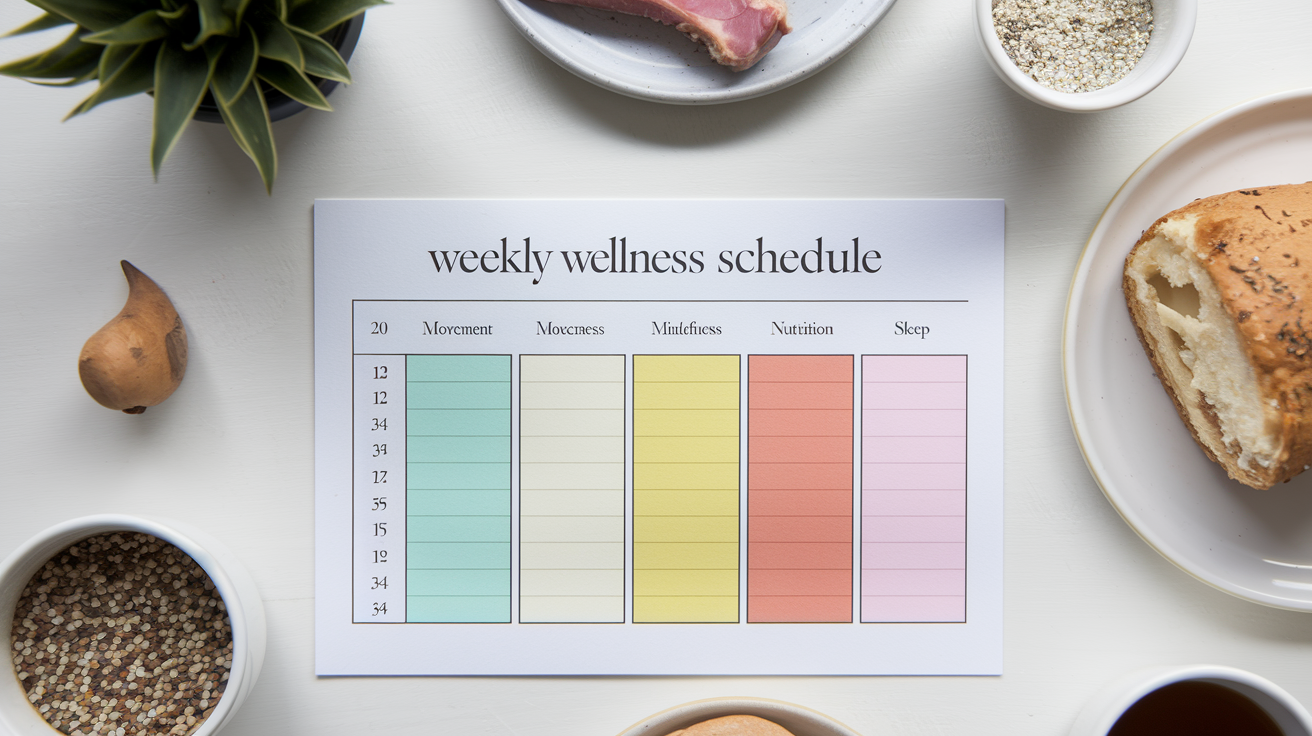
A weekly template removes decision fatigue. You don’t have to reinvent your day every morning. You plug in what works, repeat it, and adjust when something stops fitting.
| Day | Activity Type | Duration | Notes |
|---|---|---|---|
| Monday | Morning walk + breakfast | 30 minutes | Hydrate first, then walk, then eat |
| Tuesday | Evening stretch + journaling | 20 minutes | After dinner, before screens |
| Wednesday | Midday movement break + balanced lunch | 25 minutes | Stand, stretch, or walk; sit down to eat |
| Thursday | Morning meditation + intention setting | 10 minutes | Right after waking, before coffee |
| Friday | Evening walk + screen-free wind-down | 40 minutes | Walk 20, read or stretch 20 |
| Saturday | Longer movement session + meal prep | 60 minutes | Yoga, hike, or bike ride; chop veggies for the week |
| Sunday | Rest day + weekly reflection | 15 minutes | Gentle stretch, journaling, plan next week |
Customize this by swapping activities based on your energy, work schedule, and what you genuinely enjoy. If you hate mornings, move everything to the evening. If you love podcasts, pair them with walks or meal prep. The goal is repetition in a structure that fits your life, not someone else’s.
Psychology of Habit Formation and Motivation

Habits stick when they follow a simple loop: cue, routine, reward. Your brain notices a trigger (the cue), follows the action (the routine), and gets a payoff (the reward). That payoff can be as small as feeling calmer, less stiff, or proud you showed up.
Start with cues you already have. Brushing your teeth is a morning cue. Use it to stack a new habit like drinking water or stretching. Your coffee machine finishing is an evening cue. Attach a five-minute journal session or a few deep breaths before you scroll.
When you stop relying on motivation and start relying on cues, your routine becomes automatic.
Small wins increase motivation faster than big plans. Finishing a 10-minute walk feels better than skipping a planned 60-minute workout. Your brain rewards completion, not ambition. Celebrate the fact that you did the thing, even if it was shorter or simpler than you planned.
Three habit-building techniques that work:
Make it easy. Lay out your workout clothes the night before. Keep a water bottle on your nightstand. Remove friction so the habit takes less effort than skipping it.
Track it visually. Mark an X on a calendar every day you complete the habit. Seeing a streak builds momentum.
Reward immediately. After your routine, do something you enjoy. Your favorite tea, five minutes of a show, or just sitting down and breathing. The reward reinforces the loop.
Customizing Your Routine for Different Lifestyles

Your routine has to work with your schedule, not against it. A parent with two kids under five needs a different structure than someone working night shifts or someone with a flexible remote job. The principles stay the same, but the timing and format change.
Look at your non-negotiables first. Work hours, school drop-off, commute, caregiving. Then find the pockets of time you actually control. Maybe it’s 10 minutes while your coffee brews. Maybe it’s your lunch break. Maybe it’s after the kids go to bed.
Start there.
Keep a short list of backup activities for days when your main plan falls apart. A five-minute stretch instead of a 30-minute walk. A glass of water and three deep breaths instead of a full morning routine. Progress, not perfection.
Real‑Life Customization Examples
Busy parent, unpredictable mornings: Choose one evening anchor (10-minute stretch after kids are asleep) and one daily micro-habit (drink water first thing, even if breakfast is chaotic). Add morning activities only after the evening routine feels automatic.
Shift worker with variable hours: Anchor your routine to your wake-up time, not the clock. Stretch and hydrate within 30 minutes of waking, no matter when that is. Keep your wind-down routine consistent before sleep, even if “evening” is 8 AM.
Desk job, long commute: Use your commute for a podcast or audiobook on wellness topics. Schedule a mid-morning and mid-afternoon movement break. Stand, stretch, walk the hallway for 3 minutes. Prep grab-and-go breakfasts and lunches on Sunday to avoid skipping meals during the week.
Common Mistakes to Avoid When Building a Wellness Routine

The biggest mistake is trying to overhaul your entire life at once. You add morning yoga, meal prep, journaling, evening meditation, and a new sleep schedule all in the same week. By day four, you’re exhausted and back to scrolling in bed.
Start with one or two changes. Lock those in for two to four weeks before you add anything else. Your brain can only handle so much newness at once.
Common mistakes that derail routines:
Setting unrealistic goals. Committing to daily 60-minute workouts when you haven’t exercised in months. Start with 10–20 minutes three times a week and build from there.
Rigid schedules that ignore your energy. Forcing morning routines when you’re naturally a night person, or planning intense evening workouts when you’re wiped out by 7 PM. Work with your body, not against it.
Expecting instant results. Wellness routines build slowly. You won’t feel dramatically different after one week. Stick with it for a month and track small changes. Better sleep, steadier energy, fewer afternoon crashes.
Skipping rest and recovery. Packing every day with activity and wondering why you’re burned out. Rest is part of the routine. Schedule it like you schedule everything else.
Not tracking progress. When you don’t write it down, you forget what’s working. Use a calendar, planner, or simple checklist to see your consistency over time. That visual proof keeps you going when motivation dips.
Final Words
Start with the 10‑minute starter, then use the quick self‑check to spot what needs changing. These small actions spark real momentum.
Move on by stacking tiny habits, trying the activity options, and using the sample weekly template. Watch for common slipups and tweak as you go.
If you want one next step, try the 10‑minute routine for seven days — it’s the easiest way to learn how to create a wellness routine that fits your day. Small wins add up. You’ve got this.
FAQ
Q: What is the 3 3 3 rule for habit?
A: The 3 3 3 rule for habit is a small-step approach: pick one tiny habit, do it for 3 minutes, three times a day, for three weeks to build consistency and reduce overwhelm.
Q: What are the 5 C’s of wellness?
A: The 5 C’s of wellness are five focus areas—connection, calm, competence, choice, and care—that help you balance daily habits across relationships, stress, skills, decisions, and self-support.
Q: How to start a wellness routine?
A: How to start a wellness routine: begin with one 10-minute habit, schedule it, pair it with something you already do, and repeat for seven days to make it stick.
Q: What is the 5 5 5 30 rule?
A: The 5 5 5 30 rule is a quick break formula: do 5 minutes movement, 5 slow breaths, and 5 light stretches, then aim to pause like this every 30 minutes when you need a reset.