

What if your “brain fog” isn’t just being tired, but a specific kind of mental burnout that sleep alone won’t fix?
You may notice trouble focusing, slow thinking, small decisions suddenly feel huge, and motivation fades halfway through the day.
These are signs of cognitive fatigue, when your attention circuits run low on fuel and the brain shifts to easier choices.
This post explains the symptoms, causes, and recovery methods you can try today to get clearer, faster thinking back.
Clear Understanding of Cognitive Fatigue: Definition, Symptoms, and Why It Happens

Cognitive fatigue is mental exhaustion that builds when you’ve been doing effortful thinking for too long. It’s different from ordinary tiredness or sleepiness. You might’ve had eight hours of sleep, but after hours of focused work, decision making, or mentally demanding tasks, your brain starts to slow down. Concentration becomes harder. Simple tasks take longer. That’s cognitive fatigue showing up.
It happens because your brain’s attention circuits run on metabolic fuel, primarily glucose. When you focus hard for extended periods, you deplete the energy stores in the parts of your brain responsible for top-down attention. That’s the deliberate, effortful focus you use to ignore distractions and stay on task. At the same time, sustained cognitive effort triggers a buildup of glutamate, a neurotransmitter, in the prefrontal cortex. A 2022 study measured about an 8% increase in glutamate levels after participants performed mentally demanding tasks for over six hours. When glutamate accumulates, the brain appears to shift resources toward restoring balance, leaving less capacity for hard thinking. You start favoring easier, quicker decisions and your mental grip loosens.
The most common symptoms of cognitive fatigue include:
- Difficulty concentrating or staying focused on a single task
- Brain fog (thoughts feel slow, unclear, or sticky)
- Increased irritability or low motivation
- Slower processing speed and delayed decision making
- Reduced productivity despite putting in more effort
Triggers pile up fast in modern life. Prolonged mental work without breaks, endless information from screens, constant task switching, sleep deprivation, and chronic stress all strain your attention circuits. Even your environment matters. A busy city street or a corner coffee shop keeps your brain working to filter noise and movement, while a quiet park or a view of water lets those circuits rest and restore.
Neurological Foundations of Cognitive Fatigue: How the Brain’s Energy Systems Deplete

Your brain uses a lot of energy (about 20% of your body’s total glucose supply), and the prefrontal cortex, which handles complex thinking, planning, and self-control, is particularly hungry. When you engage in sustained mental effort, glucose levels in the neural circuits that support focused attention begin to drop. At the same time, the byproducts of intense neural firing start to accumulate. Glutamate, the brain’s primary excitatory neurotransmitter, builds up in the lateral prefrontal cortex during prolonged cognitive work. That buildup may force the brain to divert metabolic resources toward clearing and recycling glutamate, leaving less fuel available for the next round of effortful thinking. The result? A shift toward low-effort, short-term decisions and a reluctance to engage in tasks that require sustained control.
Other brain systems contribute as well. Adenosine, a byproduct of energy use, rises throughout the day and increases sleep pressure. Dopamine, which supports motivation and reward processing, can fluctuate under chronic demand or stress, reducing your drive to tackle hard tasks. Cortisol, the body’s primary stress hormone, rises during mental overload and can impair working memory and executive function if it stays elevated too long. Together, these neurochemical shifts create the subjective experience of cognitive exhaustion. Your brain telling you it needs a break.
Top-Down vs Bottom-Up Attention Mechanisms
Top-down attention is what you use when you deliberately focus on something. Reading a dense report, solving a problem, ignoring a notification. It requires effort, active suppression of distractions, and sustained engagement of prefrontal circuits. This mode burns through glucose and generates the metabolic byproducts that lead to fatigue.
Bottom-up attention, by contrast, is passive. It’s what happens when something naturally catches your eye: a butterfly, the shift of light on water, clouds turning red at sunset. These stimuli capture your attention effortlessly, without draining the circuits used for focused work. When you let yourself shift into bottom-up mode by spending time in quiet, visually interesting environments (especially natural settings), the circuits used for top-down control get a chance to replenish. That’s why a few minutes looking at trees or flowing water can restore your ability to concentrate when you return to work.
Cognitive Fatigue Symptoms: What Mental Exhaustion Actually Feels Like

Cognitive fatigue shows up in your day-to-day functioning, often in small but frustrating ways. You might sit down to write an email and struggle to find the right words. A decision that would normally take seconds (what to eat for lunch, which task to do next) suddenly feels overwhelming. You reread the same paragraph three times without absorbing it. Your patience runs thin. Small interruptions feel more annoying than they should. You know you need to get something done, but starting feels impossibly hard.
These symptoms tend to appear even when you’ve slept enough, because cognitive fatigue isn’t about physical tiredness. It’s about depleted mental resources. The harder you push without giving your attention circuits a real break, the more pronounced the symptoms become. Multitasking and constant context switching make it worse, because every shift in focus costs additional mental energy and speeds up the depletion process.
Common day-to-day signs of cognitive fatigue include:
- Misplacing your phone, keys, or other everyday items more often
- Forgetting what you walked into a room to do
- Taking much longer to make simple decisions
- Zoning out during conversations or meetings
- Needing to reread sentences or instructions multiple times
- Feeling mentally “stuck” even when you know what needs to happen next
Major Causes and Triggers of Cognitive Fatigue in Daily Life

The most direct cause of cognitive fatigue is sustained mental effort without adequate recovery. If you spend hours in back-to-back meetings, tackle complex problem solving all morning, or push through a demanding project without breaks, your attention circuits deplete faster than they can restore themselves. The brain doesn’t have an infinite supply of metabolic fuel or processing capacity. When you ignore early signals to rest, fatigue accumulates.
Information overload amplifies the problem. Constant notifications, open browser tabs, incoming emails, and rapid task switching force your brain to repeatedly redirect attention and suppress distractions. Each switch costs energy. Over the course of a day, the cumulative drain is significant. Digital environments are particularly taxing because they deliver a steady stream of stimuli that demand filtering and decision making, even during what you think of as downtime. Scrolling social media, answering messages, or playing a fast-paced game all require top-down attention, so they don’t restore cognitive capacity. They extend the depletion.
Sleep deprivation and chronic stress layer additional risk. When you don’t get enough sleep, your brain starts the day with reduced glucose availability and higher baseline levels of adenosine, leaving less margin before fatigue sets in. Chronic stress keeps cortisol elevated, which impairs working memory and decision making and makes it harder to disengage from worry or mental loops. Even your physical environment plays a role. Urban settings (busy streets, traffic noise, crowded spaces) require constant vigilant attention to navigate safely, whereas natural settings allow passive, restorative attention. A walk down a city block doesn’t give your brain the same recovery as a walk through a park.
Scientific Evidence Behind Cognitive Fatigue: What Studies Reveal

Research into cognitive fatigue has grown more sophisticated as imaging technology has improved. A key 2022 study published in Current Biology used magnetic resonance spectroscopy (MRS) to track neurochemical changes in 40 participants who performed cognitive tasks for more than six hours. Half completed a difficult version of a working-memory task that required holding and comparing large amounts of information. The other half did an easier version. By the end of the day, participants in the hard-task group showed an approximately 8% increase in glutamate concentration in the lateral prefrontal cortex, while the easy-task group did not. The fatigued group also became more impulsive on behavioral tests, choosing smaller immediate rewards over larger delayed ones (a hallmark of reduced cognitive control).
The study’s design controlled for general motivation and physical fatigue by comparing hard and easy task conditions. The findings suggest that cognitive fatigue has a measurable neurochemical signature and that glutamate accumulation may force the brain to prioritize metabolic cleanup over continued high-effort performance. However, the MRS technique has limitations. It can’t fully separate glutamate from closely related molecules like glutamine, and the sample size was modest, so replication is needed.
| Study Element | Description |
|---|---|
| Sample and Duration | 40 participants; cognitive tasks performed for over 6 hours |
| Key Finding | ~8% increase in lateral prefrontal glutamate in hard-task group; increased impulsivity on choice tests |
| Method and Limitation | MRS imaging; cannot fully isolate glutamate from glutamine; preliminary evidence requiring replication |
Assessing Cognitive Fatigue: Tools and Measures Clinicians Use

Clinicians and researchers use a combination of self-report questionnaires and performance-based tests to assess cognitive fatigue. Self-report tools capture the subjective experience: how tired you feel, how much effort daily tasks require, and how fatigue impacts your functioning. Performance tests, on the other hand, measure objective declines in speed, accuracy, or sustained attention that occur as fatigue builds. Together, these approaches help distinguish cognitive fatigue from other conditions like depression, sleep disorders, or neurological disease.
The most common tools are validated across different populations and clinical settings. They provide standardized scores that clinicians can track over time to monitor recovery or response to interventions. Because cognitive fatigue can overlap with physical fatigue, mood disturbance, and other symptoms, careful assessment helps clarify what’s driving the experience and what treatment approaches are most likely to help.
Common Clinical Tools
The Fatigue Severity Scale (FSS) is a nine-item questionnaire that asks you to rate statements like “I am easily fatigued” and “Fatigue interferes with my physical functioning” on a seven-point scale. It’s widely used in research and clinical practice because it’s brief and sensitive to change. The Chalder Fatigue Questionnaire assesses both physical and mental fatigue using 11 items, with separate subscales for each domain. It’s particularly useful in chronic fatigue and post-viral syndromes. The PROMIS Fatigue measure is part of a larger patient-reported outcomes system and uses item banks calibrated to the general population, allowing for precise, efficient measurement. Neuropsychological tests often include reaction-time tasks and sustained-attention paradigms (such as continuous performance tests) that reveal slowing and lapses as fatigue accumulates. Working-memory tasks can show reduced capacity and increased error rates under cognitive load.
Cognitive Fatigue vs Physical Fatigue: Understanding Key Differences

Cognitive fatigue and physical fatigue share the subjective sensation of tiredness and the need for rest, but they arise from different systems and recover in different ways. Physical fatigue reflects the depletion of energy stores in muscles, the buildup of metabolic byproducts like lactate, and sometimes localized muscle damage or inflammation. When you’re physically fatigued, your muscles feel heavy, weak, or sore. Rest, hydration, nutrition, and sleep restore muscle glycogen, clear metabolic waste, and repair tissue.
Cognitive fatigue, by contrast, is rooted in the depletion of neural energy substrates (primarily glucose in attention and executive-function circuits) and the accumulation of neurochemical byproducts like glutamate in the prefrontal cortex. Your muscles aren’t tired, but your ability to focus, make decisions, and suppress distractions is impaired. Physical rest alone doesn’t fully restore cognitive capacity. What helps most is shifting from effortful, top-down attention to passive, restorative activities: quiet environments, nature exposure, or light, non-demanding movement. Both types of fatigue improve with sleep, but cognitive recovery also depends on reducing sensory and goal-driven demands during waking hours.
Immediate Relief Strategies: How to Recover Quickly from Cognitive Fatigue

When you notice the signs of cognitive fatigue setting in (difficulty concentrating, slower thinking, rising irritability), the most effective immediate response is to step away from effortful mental work and shift into a restorative mode. Evidence shows that quiet, natural environments are particularly effective. Even a few minutes sitting by a window with a view of trees, walking through a park, or watching water flow can begin to replenish your attention circuits. The key is engaging bottom-up attention: letting your focus be gently captured by natural fascinations like birds, leaves moving in the wind, or shifting light on a pond, without demanding effort or goal-directed thinking.
Digital breaks don’t work the same way. Surfing the web, scrolling social media, answering email, or playing most video games all require top-down attention and decision making, so they extend cognitive load rather than relieving it. If you can’t get outside, looking at nature images (especially scenes with water) provides modest benefit. A nature mural in a break room restores attention better than sitting in a busy coffee shop, where the sensory environment keeps your vigilance system active.
Quick relief strategies that work:
- Take a brief walk outside, ideally in a park, garden, or tree-lined street
- Step away from all screens for at least five minutes
- Do simple stretches or slow movement without a performance goal
- Drink water (dehydration impairs cognitive function and compounds fatigue)
- Close your eyes and take a few slow, deep breaths to calm your nervous system
- Sit quietly and look at something natural or visually restful
Long-Term Prevention and Daily Habits That Reduce Cognitive Fatigue
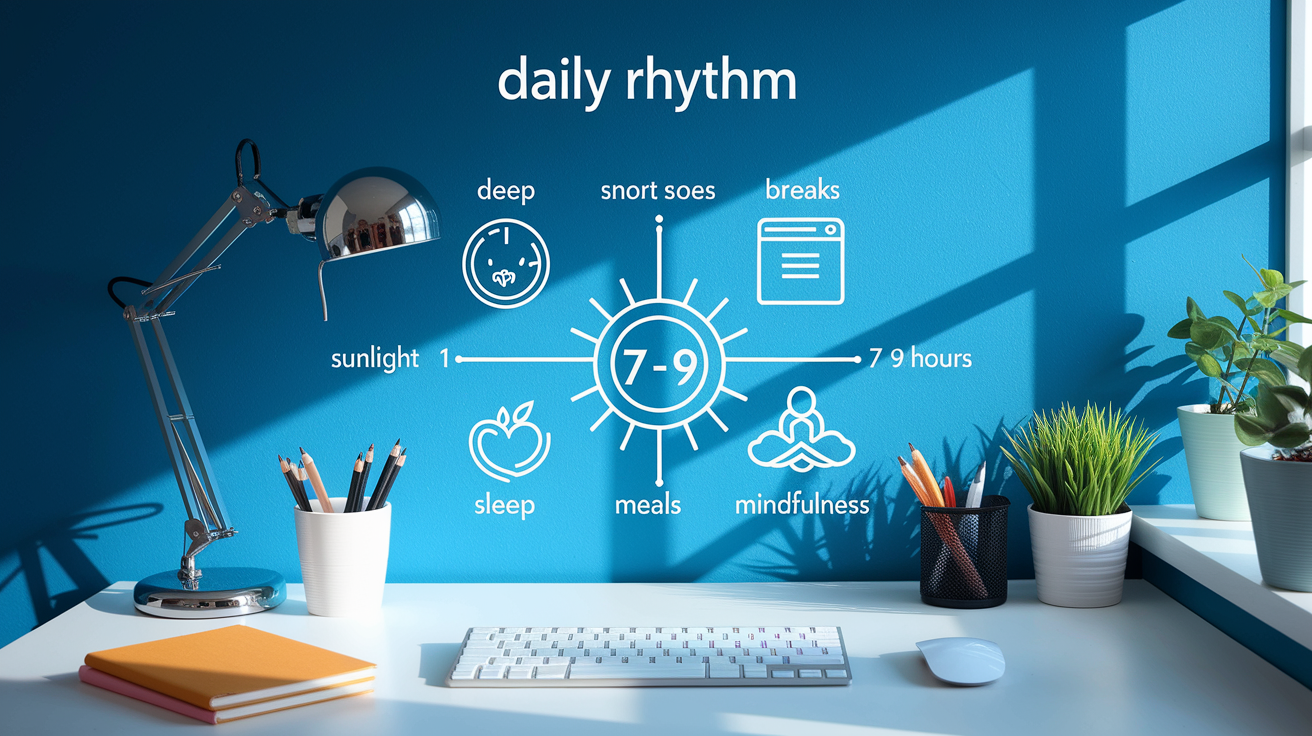
Preventing cognitive fatigue over the long term means building a daily rhythm that matches cognitive demand with adequate recovery. One of the most effective strategies is to structure your day around blocks of deep, focused work followed by proactive breaks. Deep work (uninterrupted time for cognitively demanding tasks) is best scheduled when your energy is highest, often in the morning for most people. Keep these blocks realistic, typically 60 to 90 minutes, and plan a real break afterward. Trying to push through for hours without rest accelerates depletion and reduces the quality of your output.
Sleep is foundational. Aim for seven to nine hours per night with consistent sleep and wake times, even on weekends. Sleep consolidates memory, clears metabolic waste from the brain, and restores glucose availability in neural circuits. Exposure to natural light in the morning helps regulate your circadian rhythm, making it easier to fall asleep at night and wake refreshed. Nutrition and hydration matter as well. Balanced meals with adequate protein, fiber, and healthy fats provide steady energy, and even mild dehydration can impair concentration and working memory. Mindfulness practices, even brief ones like a few minutes of focused breathing, help reduce background mental noise and improve your ability to sustain attention when you return to work.
Environmental changes that support mental stamina:
- Turn off nonessential notifications and create offline windows during the day
- Use a single-tasking approach (finish one thing before starting the next)
- Schedule short, screen-free breaks every 60 to 90 minutes
- Spend time in natural light or near windows with outdoor views whenever possible
Special Populations and Conditions Impacting Cognitive Fatigue

Certain groups experience cognitive fatigue more intensely or more frequently due to underlying conditions, developmental stage, or neurological factors. Students, especially during exam periods or heavy course loads, face prolonged mental demand with limited opportunity for recovery. Their brains are still developing executive-function capacity, and academic pressure can quickly outpace their attentional stamina. Older adults may have reduced cognitive reserve and slower metabolic recovery, making everyday tasks more fatiguing than they were earlier in life. Age-related changes in neurotransmitter systems and glucose metabolism can compound the issue.
People with multiple sclerosis (MS) often report severe cognitive fatigue as one of their most disabling symptoms, even when physical fatigue is managed. The disease disrupts neural signaling efficiency, so mental tasks require more effort and drain resources faster. Similarly, individuals recovering from traumatic brain injury (TBI) or concussion experience prolonged cognitive fatigue because the injured brain is working harder to perform normal functions while also managing inflammation and repair processes. Long COVID has emerged as another condition where cognitive fatigue (often described as brain fog) is prominent, persistent, and difficult to predict. For all these groups, pacing is critical. Shorter task durations, more frequent breaks, and careful monitoring of early fatigue signals help prevent severe crashes.
| Group | Special Consideration |
|---|---|
| Students under high academic load | Still-developing executive function; benefit from structured study blocks and mandatory breaks |
| Older adults | Reduced cognitive reserve and slower recovery; may need shorter task periods and more rest |
| MS, TBI, concussion, long COVID patients | Neurological disruption increases effort cost of thinking; strict pacing and symptom tracking essential |
When Cognitive Fatigue Warrants Professional Evaluation
Most cognitive fatigue improves with rest, better sleep, and routine adjustments. But if mental exhaustion persists for more than two to four weeks despite these changes, or if it significantly disrupts your ability to work, manage daily tasks, or maintain relationships, it’s time to see a healthcare provider. Persistent cognitive fatigue can signal underlying issues like depression, anxiety disorders, sleep apnea, thyroid dysfunction, or early neurological conditions that require specific treatment.
Seek evaluation sooner if cognitive fatigue is accompanied by severe mood changes (such as deep sadness, hopelessness, or loss of interest in things you usually enjoy), marked sleep disruption that doesn’t respond to good sleep hygiene, or notable cognitive decline beyond what you’d expect from fatigue alone, such as getting lost in familiar places or struggling to recall recent events. If you’ve had a head injury, viral illness, or new neurological symptoms like weakness, numbness, or vision changes, mention those to your provider. Early assessment can clarify whether you’re dealing with temporary overload or something that needs targeted medical or psychiatric care.
Final Words
You now know what cognitive fatigue is—mental tiredness from sustained thinking—and why it happens: attention circuits can run low on fuel and certain brain chemicals build up, making focus harder.
You saw the common signs (brain fog, slow thinking, irritability) and the usual triggers: nonstop screens, multitasking, poor sleep, and stress. You also have quick fixes and longer‑term habits to try.
Start with one small change this week. A short nature break, a timed deep‑work block, or better sleep can make cognitive fatigue feel much more manageable.
FAQ
Q: What is an example of cognitive fatigue?
A: An example of cognitive fatigue is feeling mentally drained, foggy, and slow after hours of focused work—like studying or endless emails—so you make mistakes, lose focus, and struggle to finish tasks.
Q: How do you reduce cognitive fatigue?
A: You reduce cognitive fatigue by taking short breaks, working in single-task blocks, doing quick nature or screen-free pauses, staying hydrated, and keeping sleep regular; try a ten- to fifteen-minute break every ninety minutes.
Q: What are the symptoms of cognitive burnout?
A: The symptoms of cognitive burnout include persistent mental exhaustion, trouble focusing, memory slips, irritability, slowed thinking, and low motivation that don’t improve with a single night’s sleep.
Q: How to recover from cognitive exhaustion?
A: You recover from cognitive exhaustion by resting your brain: take longer restorative breaks (nature walks, short naps), cut screen time, prioritize good sleep, hydrate, and return to focused work in short timed blocks.