
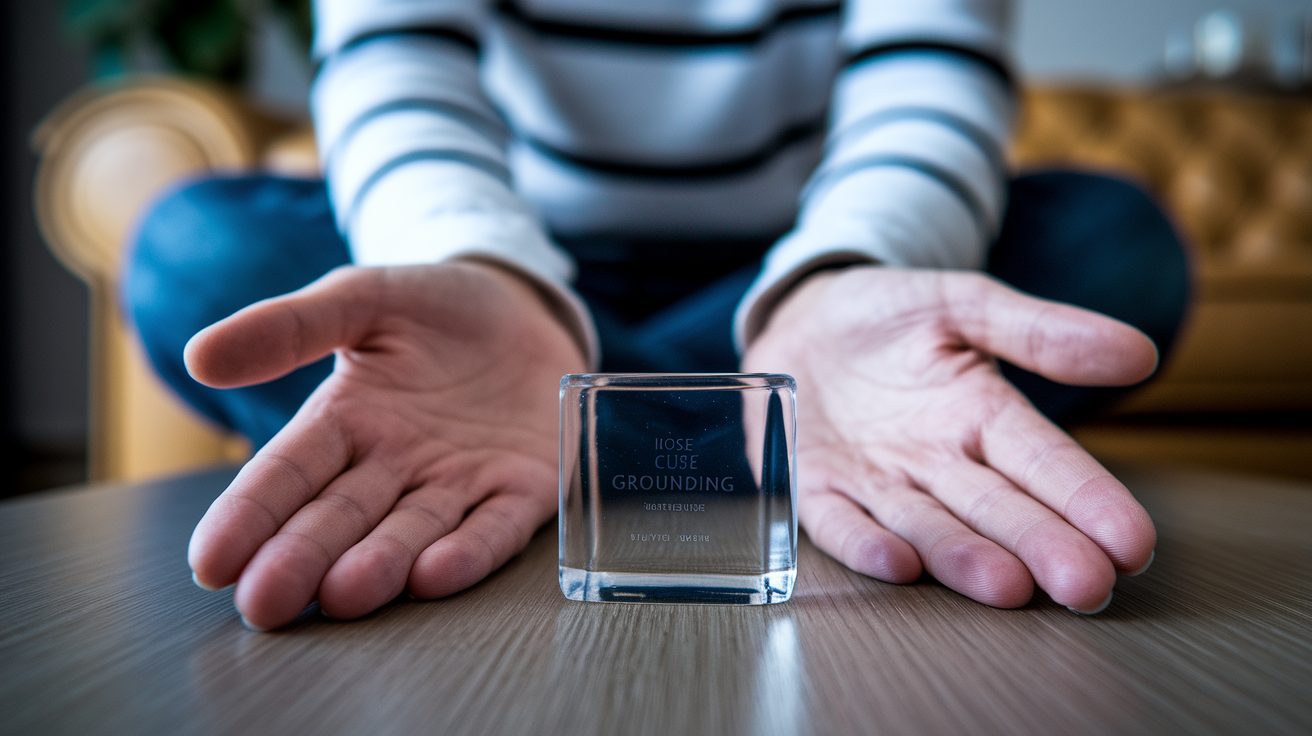
What if you could stop a panic attack in under two minutes?
When your heart races and your head spins, those minutes feel endless.
Grounding exercises work by shifting your attention from worst-case thoughts to simple, physical sensations.
They don’t promise to erase fear, but they can cut the panic loop and slow your breathing fast.
This post gives a clear, three-step routine and extra sensory tools you can use anywhere to bring your body back to calm.
Immediate Grounding Steps to Stop a Panic Attack Fast

Panic attacks are intense. They usually peak within 10 minutes and last anywhere from 5 to 20. The physical symptoms, racing heart, sweating, dizziness, chest tightness, can feel overwhelming and often trigger a second wave of fear about what’s happening to your body. The goal of immediate grounding is to interrupt that escalating cycle before it amplifies further.
A fast grounding routine works by shifting your brain’s focus away from the spiraling “what if” thoughts and redirecting attention to something concrete and sensory. When you focus on a physical sensation, temperature, texture, or controlled breath, you pull resources out of the panic circuit and signal your nervous system that you’re safe right now. Here’s a simple 3 step routine you can use the moment you notice your heart speeding up or your breathing becoming shallow:
- Find something cold and hold it firmly. Grab an ice cube, cold water bottle, or press your hands under running cold water for 30 seconds. Let the cold spread across your skin and notice the exact moment numbness begins.
- Slow your breathing with a simple count. Inhale slowly through your nose for 4 counts, hold for 4, then exhale gently through your mouth for 4. Repeat this cycle three to five times.
- Plant your feet flat on the ground. Press your heels, balls, and toes into the floor and notice the pressure. If you’re able to, stamp each foot once to deepen the sensation.
This routine takes less than two minutes and can be done anywhere. At your desk, in a restroom stall, on a bus. It engages cold sensation to jolt your attention outward and pairs that with steady breathing to restore oxygen balance. You’re not trying to “fix” the panic or force it to disappear. You’re giving your nervous system a clear, immediate cue that the threat signal can dial down.
The techniques listed in the sections that follow offer additional specialized grounding tools. Sensory methods, physical anchoring, breathing patterns, and cognitive strategies that can be practiced regularly and layered together for deeper support when you need it.
How Grounding Techniques Work During a Panic Attack

Grounding techniques interrupt the escalating loop of panic by pulling your attention out of your head and into your body and immediate surroundings. When you’re in the grip of a panic attack, your brain is convinced there’s an urgent threat, even when there isn’t one. Grounding redirects that alarm signal by engaging sensory pathways. Touch, temperature, sound, sight. These send calming feedback to the nervous system. You’re telling your body, “I’m here, I’m safe, and I can feel the floor under my feet.”
Grounding ties back to body psychotherapy approaches developed in the mid 20th century, and its use in clinical settings has been documented for decades. A 2014 survey of 113 mental health practitioners found that nearly half regularly used grounding exercises with clients experiencing anxiety, panic, and dissociation. The reason grounding has stayed in the toolkit is simple. It counters the physiological cascade of panic, hyperventilation, adrenaline surges, muscle tension, by activating the parasympathetic nervous system, the branch responsible for “rest and digest” responses. When you engage in a grounding exercise, you’re physically shifting your body out of fight or flight mode.
Grounding also addresses the cognitive spiral that feeds panic. Catastrophic thoughts like “I’m having a heart attack,” “I can’t breathe,” “I’m going to faint” amplify physical symptoms and create a feedback loop. By anchoring attention to neutral, present moment details, the texture of your jeans, the hum of the refrigerator, the cool metal of a key, you interrupt that loop and give your brain something concrete to process instead of spinning through worst case scenarios.
The Physiology Behind Panic
Panic attacks are driven by your body’s fight or flight response kicking in without a real danger present. When your brain perceives a threat, whether it’s an actual emergency or a misread signal, your hypothalamus sends a cascade of messages through your nervous system. Adrenaline and cortisol flood your bloodstream, your heart rate spikes, your breathing becomes rapid and shallow, and blood is shunted to your large muscles in case you need to run or defend yourself. These changes happen in seconds and are designed to keep you alive in the face of a predator or a car swerving into your lane.
The trouble with panic attacks is that the threat signal fires even when you’re sitting at your desk or standing in line at the grocery store. Your body is preparing for danger that doesn’t exist, and the mismatch between what you feel and what’s actually happening around you is terrifying. Here’s what’s going on inside:
Adrenaline release causes your heart to pound, palms to sweat, and pupils to dilate.
Hyperventilation reduces carbon dioxide in your blood, leading to dizziness, tingling, and a feeling of breathlessness.
Muscle tension spikes as your body braces for action, often felt as chest tightness or a lump in the throat.
Cortisol surge keeps the alarm running, making it hard to “talk yourself down” until the chemical wave passes.
Grounding techniques work because they activate the parasympathetic nervous system. The brake pedal that slows your heart rate, deepens your breathing, and tells your body the emergency is over.
Sensory Grounding Methods for Panic Attacks

Sensory grounding pulls your attention into the present by engaging your five senses. When panic narrows your focus to internal fear signals, racing heart, shallow breath, dizzy head, sensory techniques widen the lens and anchor you to the external world. The goal is to notice neutral details around you and inside your body, which interrupts the thought spiral and gives your nervous system evidence that you’re safe right now.
These methods are especially useful if you feel detached or dissociated during panic, or if catastrophic thoughts are looping faster than you can challenge them. Sensory grounding doesn’t require you to argue with your fear or convince yourself everything is fine. You simply observe what’s in front of you, what you can touch, what you can hear. That shift in focus, even for 30 seconds, can lower the intensity of the panic wave.
Sensory techniques are also portable. You don’t need equipment, a quiet room, or privacy. A cold water bottle in your bag, the texture of your sleeve, the sound of traffic outside. These are always available, which makes sensory grounding one of the most accessible tools when panic hits in public or at work.
The 5 4 3 2 1 Countdown
This method walks you through each of your senses in reverse order, pulling your attention outward step by step. Start by sitting or standing still and taking one slow breath. Then, silently or aloud, name:
5 things you can see. A water stain on the ceiling, the corner of a picture frame, the stitching on your shoe, a crack in the wall, a shadow on the floor.
4 things you can touch. The texture of your jeans, the cool metal of your phone, the armrest under your hand, the pressure of your feet on the ground.
3 things you can hear. The hum of the air conditioner, a car passing outside, the tick of a clock, your own breathing.
2 things you can smell. If you can’t smell anything obvious, bring your sleeve or a piece of fabric to your nose, or recall a recent scent like coffee or soap.
1 thing you can taste. A sip of water, the mint of gum, the lingering taste of lunch, or just the neutral taste inside your mouth.
If you’re able to whisper the words aloud, that adds another sensory channel, hearing your own voice, and can deepen the grounding effect. The 5 4 3 2 1 method typically takes about two minutes and can be repeated as many times as needed until your heart rate starts to slow.
Cold Sensation Reset
Cold is one of the fastest sensory inputs for interrupting panic. When you hold ice, press a cold can against your wrist, or splash cold water on your face, the sudden temperature change sends a sharp signal to your brain that competes with the panic alarm. The cold also activates vagal pathways, nerves that help regulate heart rate and breathing, and can trigger a mild dive reflex that slows your pulse.
Hold an ice cube in your palm and watch it melt. Notice the exact moment the cold turns to numbness, the water dripping between your fingers, the ache spreading across your skin. If you don’t have ice, run your hands under cold tap water for 30 seconds, or press a cold water bottle against the inside of your wrist or the side of your neck. The goal is sustained, focused sensation. Not a quick rinse.
Cold grounding works especially well if you’re in a private space like a bathroom or your car. If you’re in a meeting or public setting, tucking an ice pack or a small cold gel pack into your pocket or bag gives you a discreet option you can use without drawing attention.
Smell and Taste Anchoring
Your sense of smell links directly to the emotion and memory centers of your brain, which makes it a powerful grounding tool. Carry a small vial of peppermint oil, a piece of citrus peel, or a stick of cinnamon gum. When panic starts, bring the scent close to your nose and inhale slowly. Let the smell fill your awareness. Notice whether it’s sharp, sweet, earthy, or cool.
If you pair a calming scent with a positive memory, peppermint with a favorite hiking trail, lavender with bedtime routines, you create a sensory anchor that can help your nervous system recognize safety more quickly over time. Taste works the same way. A sour candy, a sip of cold water, or a strong mint can jolt your attention into the present and give your brain a concrete task. Notice the flavor, let it coat your tongue, feel the coolness or the sting.
When sensory grounding works best:
You feel disconnected from your body or surroundings.
Thoughts are racing faster than you can slow them down.
You’re in a public space and need a discreet grounding option.
You want a portable tool that doesn’t rely on talking or moving.
Sensory methods meet you where you are and require only your attention and the details already around you. They’re often the first step people reach for because they’re simple, immediate, and don’t require explanation or permission.
Breathing Based Grounding Exercises for Panic Relief

Breathing exercises are among the most researched and recommended grounding tools for panic because they directly address one of the core physical drivers. Hyperventilation. When you’re panicking, your breathing becomes rapid and shallow, which lowers carbon dioxide in your blood and triggers dizziness, tingling in your hands, chest tightness, and a sensation of not being able to catch your breath. Controlled breathing restores the oxygen carbon dioxide balance and sends a clear signal to your nervous system that the emergency is over.
The key is to slow your breath and deepen your exhale. That activates the parasympathetic nervous system and counters the adrenaline surge. Breathing techniques also give you a simple task to focus on, count to four, hold, exhale, which interrupts catastrophic thoughts and grounds you in the present moment. Here’s a step by step guide to box breathing, one of the most accessible and effective patterns:
- Inhale slowly through your nose for 4 counts. Feel your belly expand, not just your chest.
- Hold your breath gently for 4 counts. Don’t strain. Just pause at the top of the inhale.
- Exhale slowly through your mouth for 4 counts. Let your shoulders drop and your belly soften.
- Hold empty for 4 counts before starting the next inhale.
Repeat this cycle for about one minute, or until you notice your heart rate beginning to slow. If 4 counts feels too long, start with 3. The rhythm matters more than the exact number. Box breathing is supported by case studies dating back to 1985 and is widely taught in clinical settings because it’s simple, portable, and works quickly.
4 7 8 Breathing
The 4 7 8 technique uses an asymmetrical pattern, longer hold and exhale, that can feel even more calming than box breathing for some people. It’s particularly helpful if panic has spiked your heart rate and you need a tool that slows things down more aggressively. Here’s how it works. Inhale quietly through your nose for 4 seconds, hold your breath for 7 seconds, then exhale completely through your mouth for 8 seconds, making a soft whoosh sound if you’re able.
The extended exhale is the key. It forces your diaphragm to fully relax and signals your body to shift out of fight or flight. The 4 7 8 pattern has historical support for managing both panic and insomnia, and many people find that after three to four rounds, the physical intensity of the panic attack has noticeably decreased. If you can’t hold for 7 seconds comfortably, use a shorter count, 3 5 6 or 2 4 6, and gradually build up as you practice.
Breath work regulates your nervous system because it’s one of the few automatic body functions you can consciously control. When you slow your breathing, you’re sending a message to your brainstem that overrides the panic alarm. Your heart rate follows your breath rate, so a slow, steady exhale tells your cardiovascular system to stand down. Over time, practicing breathing techniques during calm moments trains your body to respond faster when panic does show up.
Physical Grounding Techniques to Reconnect With the Body

Physical grounding uses movement, pressure, and body awareness to pull you out of your head and back into your muscles, joints, and skin. When panic makes you feel detached, numb, or like you’re watching yourself from the outside, physical techniques give you a tangible anchor. They work by generating sensations strong enough to compete with the internal alarm signals and by releasing the muscle tension that builds up during a panic attack.
These methods are especially useful if you’re someone who feels panic primarily as a physical experience, tightness in your chest, shaking hands, jelly legs, or if sitting still makes the anxiety worse. Movement and pressure also help discharge the adrenaline that’s flooded your system, which is why people often report feeling calmer after pacing, stretching, or tapping their feet during a panic episode.
Physical grounding moves to try:
Run in place for 20 to 30 seconds to burn off adrenaline and redirect focus to your legs.
Walk briskly around the block or down a hallway. The rhythm of your steps can steady your breathing.
Do jumping jacks or march in place if you’re in a private space and need a bigger release.
Wiggle your toes inside your shoes, or press and release your toes against the floor.
Rise onto your tiptoes and lower back down slowly for several rounds. Notice the shift in your calf muscles.
Swing your arms gently while keeping your lower body still. Feel the weight of your hands and the stretch across your shoulders.
These movements don’t need to be intense or sustained. Even 30 seconds of deliberate motion can interrupt the freeze response and remind your body that you’re in control. If you’re in a meeting or other public setting, small discreet actions, pressing your feet into the floor, clenching and releasing your fists under the table, or gently rolling your shoulders, can provide grounding without drawing attention.
How Pressure Techniques Calm the Nervous System
Deep pressure stimulation, like the weight of a heavy blanket, a tight hug, or wrapping yourself firmly in a towel, can reduce panic symptoms by activating touch receptors that send calming signals to your brain. Weighted blankets and vests have been studied in clinical settings and are reported to help prevent panic attacks in some people, likely by providing consistent, evenly distributed pressure that mimics a safe, contained feeling.
If you don’t have access to a weighted item, you can create your own pressure grounding. Wrap a regular blanket tightly around your shoulders and torso, cross your arms and give yourself a firm hug, or press your back against a solid wall and push into it for a slow count of ten. Earlobe massage, gently pinching and rolling your earlobes between your thumb and forefinger, is another discreet pressure technique that’s surprisingly effective and can be done while sitting at your desk or in a waiting room.
Physical grounding is accessible in almost any environment and doesn’t require you to explain what you’re doing. A few toe wiggles, a quick walk to the water cooler, or a quiet stretch in a restroom stall can be enough to shift your nervous system just enough to take the edge off the panic.
Cognitive Grounding Techniques for Racing Thoughts

Cognitive grounding techniques redirect your mental focus away from catastrophic “what if” thoughts and onto neutral, concrete tasks. When your mind is spinning with fears, “I’m going to pass out,” “I’m losing control,” “Something is seriously wrong,” trying to reason your way out often backfires. Cognitive grounding works differently. Instead of challenging the thoughts, you give your brain a simple, structured job that requires just enough attention to interrupt the panic loop.
These techniques are especially helpful if your panic attacks are driven more by racing thoughts than by physical sensations, or if you tend to spiral into worst case scenarios. By shifting cognitive load onto a neutral task, naming objects, doing mental math, reciting facts, you pull processing power away from the fear circuit and reduce activity in the amygdala, the part of your brain that registers threat.
One effective cognitive grounding exercise is to name three objects around you and describe them in detail. Pick a lamp, a book, and a window. Silently label each one, then add a sentence. “The lamp is silver with a round base. The book has a green cover and gold lettering. The window has four panes and a small crack in the bottom left corner.” If you’re able to speak aloud, that’s even better. Hearing your own calm voice describing ordinary things can be surprisingly reassuring.
Another option is mental math or simple counting tasks. Count backward from 100 by sevens, recite your times tables starting with nines, or spell your last name forward and then backward. The goal is not to get the answer right. It’s to occupy your working memory so your brain has fewer resources left to fuel the panic. You can also recite personal facts in a steady rhythm. Your full name, your date of birth, your current address, the names of your siblings, the street you grew up on. These details are emotionally neutral and easy to retrieve, which makes them ideal anchors.
Examples of cognitive tasks for grounding:
Describe the room you’re in as if you’re giving a tour to someone on the phone.
List the steps of a routine task, making coffee, tying your shoes, brushing your teeth.
Name five animals that start with the letter B, then five that start with C.
Silently narrate what you can see in front of you using short, factual phrases. “White wall. Blue chair. Wooden desk. Silver stapler.”
Using Present Moment Statements for Emotional Regulation
Affect labeling, the practice of quietly naming what you’re experiencing, has been shown to reduce reactivity in the amygdala and help regulate emotions. During a panic attack, you can use simple present moment statements to ground yourself without trying to argue with the panic. Try saying, silently or aloud, “I’m sitting in a chair. My feet are on the floor. I can hear the hum of the air conditioner. My hands are resting on my lap. I am safe right now.”
These statements aren’t affirmations or positive thinking. They’re just observations. You’re not telling yourself “everything is fine” or “there’s nothing to worry about.” You’re describing what’s true in this exact moment, which can create a small pocket of calm in the middle of the storm. If your mind immediately jumps back to fear, that’s okay. Gently return to the statements and repeat them as many times as you need.
Cognitive grounding helps rebuild a sense of safety by anchoring you in facts and sensory details that are neutral and verifiable. It doesn’t require you to believe the panic is over or to force yourself to relax. It simply asks you to notice what’s real, right now, in the space around you.
Building a Personalized Grounding Toolkit for Panic Episodes

A grounding toolkit is a small, portable collection of exercises and objects you keep ready so you can respond to panic quickly without having to think through your options in the middle of an attack. The key is to identify which techniques work best for you, practice them when you’re calm, and assemble the physical items that support those techniques. Ice packs, textured stones, peppermint gum, a grounding card with step by step instructions.
Start by paying attention to your early cues. Does your panic usually begin with a racing heart, shallow breathing, or a wave of dizziness? Do you first notice it in your chest, your stomach, or your head? Naming those early signals improves your success because you can start grounding as soon as the symptoms begin, before the panic fully peaks. Keep a short note in your phone or a card in your wallet that lists your top three grounding techniques and the first step for each one. When panic hits and your thoughts scatter, that external reminder can guide you back.
Quick practice prescriptions help you build automaticity. Try a 30 second grounding drill each morning. Box breathing while your coffee brews, a quick 5 4 3 2 1 scan while you’re getting dressed. So your brain learns to associate these exercises with calm, not just crisis. Aim for two 30 second practice sessions a day. With consistent reps, neural pathways begin to rewire in about two weeks, and you’ll find it easier to access the techniques when you need them most.
| Tool | How to Use It | When to Use It |
|---|---|---|
| Ice pack or cold gel pack | Press against wrist or neck for 30 seconds | At home, in car, in private restroom |
| Textured stone or coin | Hold in pocket and trace edges; notice weight and temperature | Meetings, commute, anywhere discreet grounding is needed |
| Peppermint gum or oil | Chew slowly or inhale scent deeply | Public settings, during travel, anytime a strong sensory cue helps |
Tracking effectiveness can help you refine your toolkit over time. After you use a grounding technique, jot a quick note in your phone. What you tried, how intense the panic was before, rate 1 to 10, and how you felt after. If you notice that cold sensation consistently drops your rating by three or four points but mental math barely moves the needle, lean into the cold techniques and practice those more often. Rotate objects. Swap your grounding stone every few weeks or try a new scent to keep the sensory input fresh and effective.
When Grounding Exercises Aren’t Enough: Getting Additional Support

Grounding techniques are powerful in the moment tools, but they don’t address the underlying patterns that drive recurrent panic attacks. If you’re using grounding exercises weekly or more, if panic is starting to shape your choices, avoiding certain places, skipping social events, changing your commute, or if you’re experiencing thoughts of self harm, it’s time to connect with a mental health professional.
Cognitive behavioral therapy, exposure therapy, and mindfulness based interventions have strong research support for reducing the frequency and severity of panic attacks over time. These therapies help you identify triggers, challenge catastrophic thinking, and gradually build tolerance to the physical sensations of anxiety so they feel less threatening. Therapy doesn’t replace grounding. It builds a foundation that makes grounding more effective and reduces how often you need it.
Signs you should seek professional support:
Panic attacks happen once a week or more frequently.
You’re avoiding activities, places, or people because of fear of having an attack.
Physical symptoms are severe enough that you’ve gone to the emergency room or urgent care to rule out a medical cause.
You’re experiencing persistent worry between attacks, constant background anxiety, or thoughts of harming yourself.
If you’re unsure whether your symptoms are panic or something else, especially if you’re experiencing chest pain, shortness of breath that doesn’t improve with grounding, sudden severe headache, or confusion, seek immediate medical evaluation. Panic attacks can mimic cardiac and neurological emergencies, and it’s always safer to rule out a medical cause first.
Long term management of panic disorder often combines therapy, grounding skills, and sometimes medication. Working with a therapist or psychiatrist gives you a structured plan, accountability, and the chance to adjust your approach as you learn what works. Grounding techniques are part of that plan, not a replacement for it.
Start with a quick cold sensation plus steady breaths — that single, fast routine is meant to stop a panic attack while it’s rising.
We also covered why grounding works, sensory options, breath patterns, physical moves, thinking strategies, how to build a portable kit, and when to get extra help.
Practice the short drill a few times a day, tuck a small item in your pocket, and note what helps.
With simple, repeatable grounding exercises for panic attacks you can lower intensity and feel more in control — small steps really add up.
FAQ
Q: What are the natural remedies for panic attacks?
A: The natural remedies for panic attacks include controlled breathing, cold‑sensation resets (ice or cold water), gentle movement like walking, staying hydrated, and brief grounding steps to reduce intensity and regain control.
Q: What is the immediate help for panic attack?
A: Immediate help for a panic attack is a cold‑sensation reset plus focused breathing: hold ice or splash cold water, then take slow breaths with a longer exhale for four to six cycles until you feel calmer.
Q: What is the 5 4 3 2 1 grounding technique for anxiety and what is the 3 3 3 rule for panic attacks?
A: The 5‑4‑3‑2‑1 technique guides your senses—name 5 things you see, 4 you feel, 3 you hear, 2 you smell, 1 you taste. The 3‑3‑3 rule is notice 3 things you see, 3 you feel, and take 3 slow breaths.