

Think your tiredness is just something you have to live with?
The Fatigue Severity Scale turns nine quick answers into a simple number that shows how much fatigue is actually affecting your day.
In under a minute you’ll calculate a mean score, see whether it hits the common 4.0 cutoff for clinically significant fatigue, and know whether to track it or bring it up with a provider.
This post walks you step-by-step through scoring, interpretation, examples, and next steps.
How Fatigue Severity Scale Scoring Works Step-by-Step
The FSS asks you to rate nine statements about fatigue on a seven-point scale. You pick a number from 1 to 7 for each one. A 1 means you strongly disagree. A 7 means you strongly agree. Your answers reflect how fatigue’s been affecting you over the past week. Each item tackles a different angle, things like how tired you feel at work, whether you can keep up with family stuff, how your body responds to activity, and whether you’ve got any motivation left at the end of the day.
Once you’ve answered all nine, the scoring is pretty straightforward. Add up your nine numbers. That total can land anywhere from 9 to 63. Then divide that sum by 9. Here’s the formula: FSS score = (sum of all nine items) ÷ 9. What you get is a mean score between 1.0 and 7.0. That mean is what clinicians and researchers actually use to figure out how severe your fatigue is.
The whole thing takes less than a minute. You can do the math on your phone or scribble it on a napkin. Higher scores point to more severe fatigue and bigger disruptions to your daily routine.
Here’s the full process:
- Check that all nine items have answers. You need one response (a number from 1 to 7) for every statement.
- Add up your nine scores. Grab a calculator or do it in your head. Get a total.
- Divide that total by nine. Take your sum and divide it by 9. That’s your mean FSS score.
- Write down the mean, usually to one or two decimal places. If your total is 39, you get 39 ÷ 9 = 4.33.
- Compare your mean to the clinical cutoff. A mean of 4.0 or higher is the common marker for fatigue that’s clinically significant.
A mean of 4.0 or above suggests fatigue is messing with your ability to function. It doesn’t diagnose anything, but it does flag the point where fatigue’s probably bad enough to track over time or bring up with a provider. Scores below 4.0 generally point to low or moderate fatigue that might not need formal intervention.
Fatigue Severity Scale Structure and Measurement Format

The FSS is nine statements. You rate how much fatigue’s impacted your life over the past week. Each statement zooms in on a different piece of the puzzle: motivation, physical stamina, work performance, family responsibilities, social life. You respond by choosing a number from 1 to 7. A 1 means the statement doesn’t fit you at all. A 7 means it describes your situation completely. The whole thing’s designed to be quick so that filling it out doesn’t drain what little energy you’ve got left.
Because it’s self-report, the FSS captures your own take on fatigue instead of relying on a clinician’s observation or lab work. It gives you a way to quantify something that can feel impossible to put into words. You don’t need special equipment, training, or someone to interpret it for you. You can fill it out on paper, answer it on a tablet, or knock it out during a telemedicine call.
You can use the FSS in a few different formats:
- Paper or PDF that you complete with a pen and score by hand
- Digital or app-based version on a computer, tablet, or phone
- Automated online tool that saves your responses, calculates your score, exports data, and sends you reminders for follow-ups
- Interview format where a clinician or research assistant reads the statements and records what you say
Most people finish all nine items in under a minute. That simplicity is why the FSS fits into busy clinics, home monitoring routines, and big research studies where time’s tight.
Interpreting Fatigue Severity Scale Scores and Clinical Cutoffs
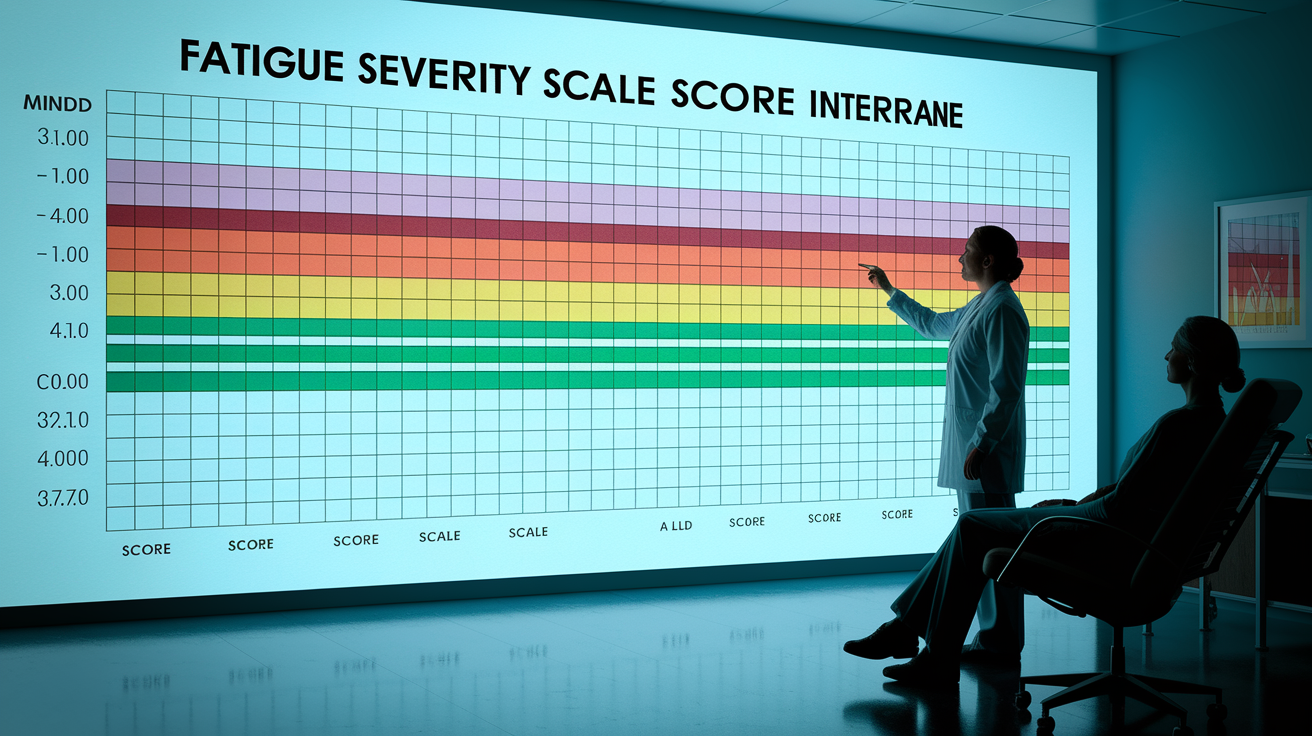
Once you’ve got your mean FSS score, you need to know what it’s actually telling you. The possible range is 1.0 to 7.0. A score on the low end means fatigue isn’t really getting in your way. A score on the high end signals severe fatigue that limits most of what you do. The most common clinical cutoff is a mean of 4.0 or higher. That’s the line where fatigue becomes clinically significant, meaning it’s probably affecting your work, relationships, self-care, or overall quality of life.
Scores below 3.0 usually reflect minimal fatigue. You might feel wiped out after a long day or a bad night’s sleep, but it’s not persistent or disabling. Scores between 3.0 and just under 4.0 suggest mild to moderate fatigue. You notice it, but it doesn’t consistently stop you from doing things. Once your mean hits 4.0 or higher, you’re looking at moderate to severe fatigue. At that level, you might be canceling plans, needing frequent rest breaks, struggling to keep up at work, or feeling too exhausted to handle basic household tasks.
A high FSS score doesn’t diagnose the cause. But it does flag that the symptom’s serious enough to dig into. A provider might use your score to decide whether to order more tests, adjust meds, suggest lifestyle tweaks, or send you to a specialist. Tracking your score over weeks or months can show whether a treatment’s helping or if things are getting worse.
| Score Band | Mean Score Range | Interpretation |
|---|---|---|
| Minimal fatigue | 1.0 to <3.0 | Low impact on daily functioning; fatigue is mild or infrequent |
| Mild to moderate fatigue | 3.0 to <4.0 | Noticeable fatigue but not consistently disabling |
| Clinically significant fatigue | 4.0 to 7.0 | Moderate to severe fatigue; interferes with work, family, and physical activities |
Worked Examples of Fatigue Severity Scale Scoring

Seeing the math in action makes everything click. Worked examples walk you through the process of turning nine individual scores into a single mean you can actually interpret and track. They also show the gap between low fatigue and clinically significant fatigue, so you can see where your own score lands and what it might mean for next steps.
Here are two sample calculations:
-
Example A: Clinically significant fatigue
Someone rates the nine items like this: 4, 5, 3, 6, 5, 4, 4, 5, 3. Add those up and you get 39. Divide 39 by 9 and your mean FSS score is 4.33. Since 4.33 sits at or above the 4.0 cutoff, this score points to moderate to severe fatigue that’s probably messing with daily responsibilities and quality of life. This person might benefit from more assessment or a focused treatment plan. -
Example B: Low fatigue
Another person answers with a 2 for all nine items. The sum is 18. Divide 18 by 9 and you get a mean of 2.0. A mean of 2.0 falls well below the clinical cutoff. That reflects minimal fatigue that isn’t really interfering with functioning. No immediate clinical intervention might be needed, though the score’s still useful as a baseline if fatigue gets worse down the road.
Clinical Use of Fatigue Severity Scale Scoring in Medical Conditions

Fatigue hits around 80% of people with lupus. It’s one of the most common and debilitating symptoms in systemic autoimmune diseases. The FSS gives clinicians a concrete way to measure how much fatigue’s interfering with someone’s life and to separate fatigue from clinical depression, which can look pretty similar. By tracking FSS scores over time, providers can tell whether treatments, lifestyle changes, or medications are actually helping to reduce the burden.
The FSS is also big in multiple sclerosis, where fatigue’s often the most disabling symptom even when physical disability is mild. In chronic fatigue syndrome, Parkinson’s, post-stroke recovery, and a bunch of other neurological and autoimmune conditions, the FSS offers a standardized snapshot that can be compared across visits, studies, and patient groups. It helps providers move past vague complaints of “tiredness” to a number that informs treatment planning and outcome tracking.
Because it’s short and doesn’t require special training, the FSS fits easily into routine clinic workflows. A nurse hands it to you at the start of a visit. You fill it out while waiting. The provider reviews your score during the appointment. That score gets added to your medical record and becomes a reference point for future visits.
Common clinical scenarios where FSS scoring comes in handy:
- Baseline assessment at diagnosis to document how severe fatigue is right from the start
- Treatment monitoring to see if a new med, therapy, or lifestyle shift is actually cutting down fatigue
- Research enrollment to make sure study participants meet fatigue criteria or to track outcomes in trials
- Disability evaluation where putting a number on functional impairment supports documentation for workplace accommodations or benefits applications
For more on how fatigue’s measured and managed in lupus, check out Fatigue Severity Scale (FSS) and Lupus.
Reliability and Validity of the Fatigue Severity Scale

The FSS was first published in 1989. Since then it’s become one of the most widely used fatigue measures in research and clinical practice. The original development study’s been cited nearly 3,000 times, which tells you how broadly it’s been accepted across specialties and conditions. That study tested the FSS in people with multiple sclerosis and systemic lupus and showed strong internal consistency and construct validity. Internal consistency measures how well the nine items work together to capture a single underlying concept. The FSS consistently pulls Cronbach’s alpha values around 0.95, which is excellent reliability.
Test-retest reliability shows how stable your scores stay when you complete the FSS twice over a short stretch without any real change in fatigue. Studies report intraclass correlation coefficients around 0.91 in some groups and 0.742 in others. Both suggest good to excellent stability. That means if your fatigue hasn’t actually shifted, your FSS score should stay roughly the same from one week to the next. That stability matters when you’re trying to track real changes instead of random noise.
Validity evidence includes correlations with other established fatigue and quality-of-life measures. The FSS shows a strong negative correlation (r = −0.77) with the Functional Assessment of Chronic Illness Therapy–Fatigue scale. Higher FSS scores align with lower functional well-being. It also correlates moderately with disease-specific quality-of-life tools and shows expected relationships with physical functioning, energy level, and symptom burden. These correlations confirm the FSS measures what it’s supposed to and that scores meaningfully reflect what living with fatigue actually feels like. For a fuller review of the psychometric properties and applications, see Fatigue Severity Scale (FSS): Full Guide.
Practical Documentation and Tracking of Fatigue Severity Scale Scoring
When you score the FSS in a clinical setting or on your own, write down the mean score to one or two decimal places along with the date. Recording the date matters because fatigue can swing with disease activity, medication changes, sleep quality, stress, and other factors. A single score gives you a snapshot. A series of scores over weeks or months shows a pattern that can guide decisions about treatment tweaks or lifestyle adjustments.
Plenty of clinics and research studies now use automated tools or electronic health record integrations to capture FSS responses, calculate scores instantly, and store the data in a format you can export or share with your care team. Automated systems can also send reminders to complete the FSS at regular intervals, which boosts adherence and cuts down the chance that follow-up assessments get forgotten. If you’re managing fatigue on your own, set a weekly or monthly calendar reminder to fill out the questionnaire and keep a simple log of your scores in a notebook or spreadsheet.
In clinical practice, providers often document both the total raw score (the sum before dividing by nine) and the mean score. Including both numbers allows for cross-study comparison and makes it clear which scoring method was used. You might see something like “FSS total 39, mean 4.33, assessed 2025-04-15.” That format tells anyone reviewing the record exactly where the score falls relative to the clinical cutoff and when the measurement was taken.
Common reporting formats:
- Baseline and follow-up pairs: “Baseline mean 5.2 (date), follow-up mean 3.8 (date), change −1.4”
- Categorical interpretation: “Mean 4.5, clinically significant fatigue present”
- Longitudinal trend summary: “Mean scores over three months: 5.0 → 4.6 → 4.1; declining trend indicates improvement”
Limitations and Considerations When Using Fatigue Severity Scale Scoring

The FSS is self-report. It relies on your own perception and how willing you are to answer honestly. Social desirability bias can push some people to underreport symptoms, especially in workplace or disability evaluation contexts where there’s pressure to look healthier. On the flip side, someone who’s overwhelmed or seeking validation might score items higher than their actual experience. These biases don’t invalidate the FSS, but they’re worth keeping in mind when you’re interpreting scores, especially in high-stakes situations.
The FSS focuses on severity and functional impact. It doesn’t capture the full picture. It doesn’t ask about the specific timing of fatigue during the day, the quality of the sensation (heavy versus wired, physical versus mental), or contributing factors like sleep, pain, or mood. That narrow focus is intentional and keeps the tool brief. But it means the FSS works best alongside other assessments. For a fuller picture, clinicians often pair it with sleep diaries, mood questionnaires, or more detailed multidimensional fatigue scales.
The FSS was developed and validated in adults, mostly folks aged 18 and older. It hasn’t been formally validated for kids or adolescents, so interpreting scores in younger age groups takes caution. The 4.0 cutoff is widely used, but it’s not universally standardized. Some studies use slightly different thresholds or treat scores as a continuous variable instead of applying a binary cutoff. Cultural and language differences can also shift how items are understood and scored, even when the FSS has been translated and adapted.
Key constraints to keep in mind:
- Self-report bias: answers depend on individual perception and honesty
- Narrow scope: doesn’t capture all dimensions of fatigue like timing, quality, or root causes
- Age restriction: not validated for children or adolescents; use in pediatric populations is off-label
Final Words
Quick recap: the FSS is nine short statements you rate 1–7. To score, check all nine answers, add them, then divide by nine to get the mean. A mean of 4.0 or higher suggests clinically significant fatigue.
This piece covered the scoring formula, the 1–7 Likert layout, worked examples, clinical uses, reliability, and tracking tips.
Use these simple steps when you next measure tiredness—fatigue severity scale scoring is quick, easy to track, and makes follow-up feel doable. Small tracking steps add up.
FAQ
Q: How is the fatigue severity scale scored? / How to score the fatigue assessment scale?
A: The fatigue severity scale is scored by rating nine statements from 1–7, summing them, then dividing the total by 9 to get a mean (range 1.0–7.0); mean ≥4.0 suggests clinically significant fatigue.
Q: What is a normal fatigue score?
A: A normal fatigue score is usually below 3.0; mean 1.0–<3.0 indicates minimal fatigue. Scores 3.0–<4.0 are mild–moderate, while a mean ≥4.0 shows clinically meaningful fatigue.
Q: What are the 5 P’s of fatigue?
A: The 5 P’s of fatigue are prompts for assessment: Predisposing (risk), Precipitating (trigger), Perpetuating (what keeps it going), Pattern (timing), and Psychological (mood/stress) factors.