

Think tracking steps and sleep is enough? You’re missing most of your wellness.
Wellness shows up in eight areas—emotional, physical, social, intellectual, spiritual, occupational, environmental, and financial.
This post teaches simple systems to measure them without extra stress.
Start with a quick 1–10 baseline, use a two- to five-minute nightly log, and do a short monthly review.
You’ll spot patterns before they become problems and make small fixes that actually stick.
Read on for easy templates and a 7-day plan you can start tonight.
Practical Methods to Track All 8 Dimensions of Wellness

Start with a baseline score for each of the eight dimensions. Use a simple 1–10 scale. Find a quiet moment this week and rate yourself honestly across all eight areas: emotional, physical, social, intellectual, spiritual, occupational, environmental, and financial. Write those numbers down. That’s your starting line.
A score of 7 or above? You’re maintaining well. Between 4–6 signals an area that needs focused attention over the next month. Anything 3 or below is your priority zone. Time to build a short-term plan and consider outside support if the score stays low.
Once you’ve got your baseline, create a weekly habit log. This can live in a notebook, a notes app, or a simple spreadsheet. Whatever you’ll actually open. Each evening, spend two to five minutes noting one quick observation per dimension. Did you move your body today? Did you connect with someone? Did you spend five minutes on something that stretches your brain or settles your spirit?
You’re not writing essays. One word or a quick check mark works. The goal is capturing patterns without adding stress.
At the end of each month, pull out those weekly logs and create a monthly wellness overview. Re-score each dimension 1–10 and compare it to your baseline. Look for trends. Did your physical score climb after three weeks of better sleep? Did your financial score drop during a month of untracked spending? Month-to-month comparison shows you what’s working and what’s sliding before it becomes a bigger problem.
Here’s a quick-start metric to track for each dimension, one measurement that moves the needle without overwhelming you:
- Emotional: Daily mood score, 1–10, plus the number of stressful episodes you noticed this week.
- Physical: Hours of sleep per night and total movement minutes per week. Walking, stretching, dancing, anything that gets your body working.
- Social: Number of meaningful conversations or interactions per week. Not surface-level check-ins, the ones that leave you feeling connected.
- Intellectual: Hours spent learning something new each week. Podcasts, articles, videos, conversations that challenge your thinking.
- Spiritual: Minutes per week spent in reflection, meditation, nature, or activities that remind you of your values and purpose.
- Occupational: Weekly energy audit. Count tasks that energize you versus tasks that drain you, and rate your overall job satisfaction 1–10.
- Environmental: Hours per week spent in spaces that feel safe, pleasant, and supportive, plus one small improvement you made to your surroundings.
- Financial: Tracking all expenses for seven consecutive days once per month, plus your current emergency fund balance or savings rate.
Tracking takes two to five minutes per day when you use this structure. No fancy apps required. A piece of paper and a pen work. So does a basic spreadsheet or the notes section of your phone.
The system matters less than the consistency. Pick the tool that removes friction, not the one that looks impressive but never gets opened.
Understanding the 8 Dimensions of Wellness for Effective Tracking

Wellness isn’t one thing. It’s eight interconnected pieces that all affect each other.
When one dimension drops, the others feel it. Sleep poorly for a week and your emotional resilience falls. Let financial stress build and suddenly your spiritual clarity and occupational satisfaction take hits too. The eight-dimension model recognizes this ripple effect. Tracking all eight gives you a full picture instead of a narrow slice.
The eight dimensions work like the threads in a piece of fabric. Pull one too tight or let another go slack, and the whole thing warps. Balanced wellness doesn’t mean scoring a perfect 10 in every area all the time. It means noticing when one dimension is out of sync and adjusting before it pulls the rest down with it.
Here’s what each dimension covers, in one line:
Emotional wellness: Your ability to cope with stress, recognize and express feelings, and maintain self-awareness about your strengths and growth edges.
Physical wellness: Nutrition, sleep, movement, and preventive care. The daily habits that keep your body functioning well.
Social wellness: Quality relationships, support systems, and a sense of belonging with people who see and value you.
Intellectual wellness: Learning, creativity, curiosity, and expanding your thinking through new ideas and experiences.
Spiritual wellness: Connection to personal values, purpose, and meaning. Not necessarily religious, but grounded in what matters most to you.
Occupational wellness: Alignment between your work (paid or unpaid) and your values, plus a sustainable balance between work time and personal time.
Environmental wellness: Safe, supportive surroundings at home, work, and in your community. Spaces that help rather than harm your wellbeing.
Financial wellness: Understanding your income, expenses, and debt. Living within your means and working toward financial goals that reduce stress.
Knowing these definitions matters because vague goals produce vague results. “Get healthier” is hard to track. “Sleep seven hours per night five nights this week” is measurable.
When you understand what each dimension includes, you can pick concrete indicators that tell you whether you’re moving forward or sliding back. Clear definitions turn wellness from an abstract concept into something you can actually monitor and improve.
Tracking Physical Wellness Metrics Effectively
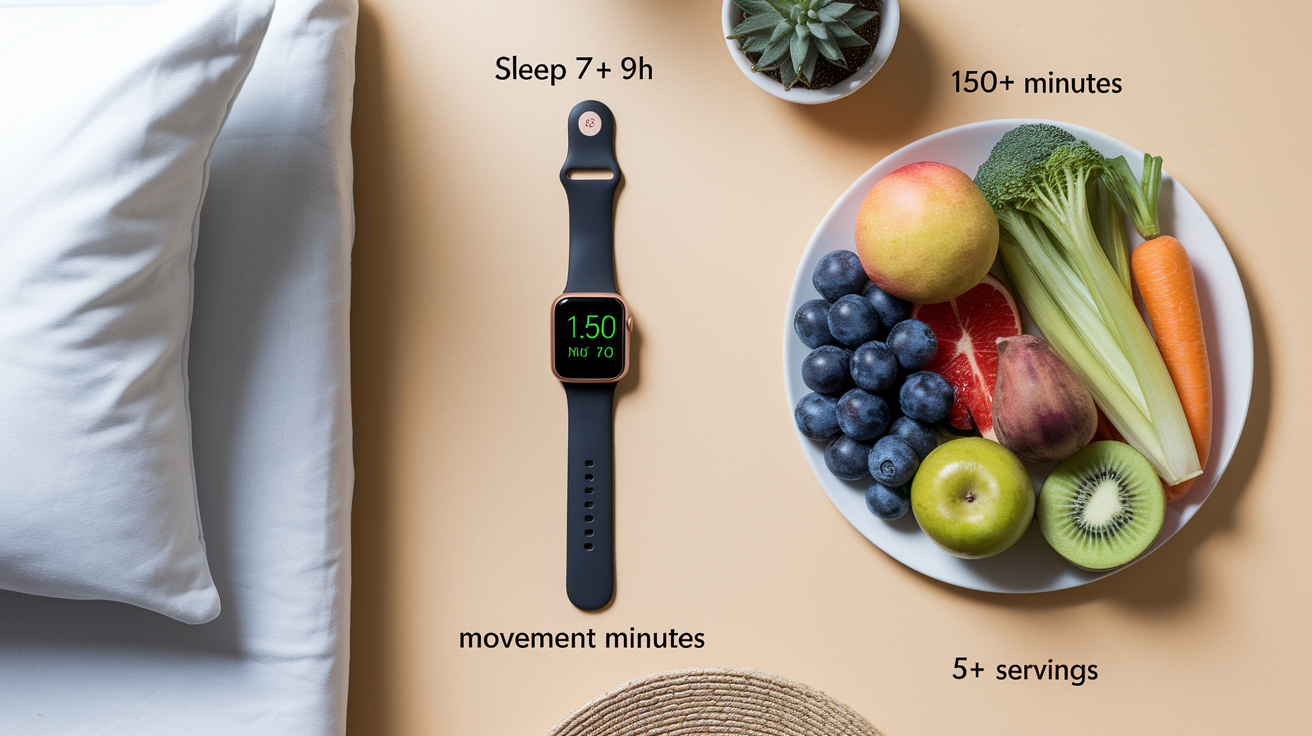
Physical wellness sits on three pillars: sleep, movement, and nutrition.
Start by tracking sleep hours each night and your energy level the next day on a 1–10 scale. Most adults need seven to nine hours. If you’re consistently under seven, that’s your first fix.
Movement comes next. Log total minutes per week, whether that’s walking, stretching, strength work, or dancing in your kitchen. Aim for 150 minutes of moderate activity per week as a baseline, but any increase from where you are now counts as progress.
For nutrition, track servings of fruits and vegetables per day. Five or more is the target. Notice your hydration too. Are you drinking water throughout the day, or running dry until evening?
Weekly summaries make the data useful. Every Sunday, add up your sleep hours, movement minutes, and produce servings. Compare to last week. Did you hit your targets three days out of seven? Five? All seven?
Progress isn’t perfection. It’s direction. If your numbers are climbing or holding steady, your system is working.
| Metric | Target Range | Tracking Method | Review Frequency |
|---|---|---|---|
| Sleep hours | 7–9 hours/night | Manual log or wearable | Daily + weekly summary |
| Movement minutes | 150+ minutes/week | Step counter, wearable, or manual log | Daily + weekly total |
| Fruit/vegetable servings | 5+ servings/day | Food journal or quick tally | Daily + weekly average |
| Energy level | 6–8 out of 10 | Daily 1–10 rating | Daily + weekly trend |
Wearables like fitness trackers or smartwatches automate some of this work. They’ll count steps, estimate sleep stages, and track heart rate variability, which reflects recovery and stress. But you don’t need tech to make progress.
A notebook and a five-minute evening check-in will do the job. The key is consistency. Pick the method that fits your routine, then run it for at least four weeks before you evaluate whether it’s helping.
Combining wearable data with a manual energy log gives you both the numbers and the context. How you actually felt, not just what the device recorded.
Tracking Emotional & Mental Wellness with Simple Tools

Emotional wellness starts with awareness.
Each evening, rate your overall mood for the day on a 1–10 scale. Write it down along with one or two words describing what you felt most strongly. Anxious, calm, frustrated, content, whatever comes up. That’s your baseline emotional data.
Over a week, patterns emerge. Maybe your score drops every Wednesday after a certain meeting. Maybe it climbs on mornings you take a walk before work. You can’t fix what you don’t notice.
Add a second layer by counting stress episodes per week. Moments when you felt overwhelmed, snapped at someone, or needed to step away and reset. Track these without judgment. You’re gathering information, not grading yourself.
If you’re seeing three or more high-stress moments per week for a month straight, that’s a signal to adjust something. Your schedule, your boundaries, or your support system. If you’re in therapy or counseling, log the number of sessions per month. Consistency there often correlates with improved emotional scores over time.
Here are five simple prompts you can use for a nightly emotional check-in, just one to three lines per question:
- What’s one emotion I felt strongly today, and what triggered it?
- Did I feel grounded and present, or scattered and reactive?
- What drained my energy today, and what restored it?
- Did I ask for help or support when I needed it, or did I push through alone?
- What’s one thing I’m grateful for or proud of from today?
Weekly reviews pull the daily dots together. Every Sunday, flip back through your mood scores and journal lines. Notice themes.
Are you consistently rating higher on days you connect with a friend? Lower on days you skip meals or sleep poorly? Those connections show you where small changes create big shifts.
If you’re working with a therapist, bring your weekly summary to your session. It gives both of you concrete data to guide the conversation instead of relying only on memory, which tends to focus on extremes and miss the steady middle patterns that actually shape your daily life.
Tracking Social Wellness and Meaningful Connections

Social wellness isn’t about the number of people you know. It’s about the quality and regularity of connections that leave you feeling seen, supported, and like you belong.
Start by counting meaningful interactions per week. Conversations where you shared something real or listened to someone else do the same. Aim for at least three. These can be in person, on the phone, or even a thoughtful text exchange. What matters is the depth, not the medium.
Next, map your support network. Write down two to five people you can reach out to when you’re struggling, celebrating, or just need to talk. If that list feels short or uncertain, that’s useful information. Building a support system becomes a trackable goal. Reconnect with one person this month, join one group or activity where you might meet like-minded people, say yes to one invitation you’d normally decline.
Here are five measurable indicators to track for social wellness:
- Number of meaningful conversations or interactions per week (target: 3 or more)
- Size of your active support network. People you’d call in a crisis or to share good news (target: 2–5)
- Social activities or gatherings per month where you felt connected, not drained (target: 2–4)
- Quality rating after social time: nourishing (adds energy) versus draining (depletes energy)
- Frequency of reaching out first versus only responding when others initiate (aim for balance)
Weekly reflection helps you notice patterns in your social life. After each interaction or gathering, jot down whether it left you feeling energized or depleted.
Over a month, you’ll see which relationships and settings nourish you and which ones consistently drain you. That doesn’t mean you cut everyone who feels hard. Some relationships require effort because they matter.
But if most of your social time leaves you exhausted, it’s worth asking whether you’re overextending, spending time with the wrong people, or skipping the connections that actually fill you up. Adjust your social calendar based on what the data shows, not what you think you “should” be doing.
Tracking Intellectual Wellness and Learning Progress

Intellectual wellness thrives on curiosity and growth. It’s not about being the smartest person in the room. It’s about keeping your mind active, engaged, and expanding.
Start by logging hours per week spent on learning activities. Reading, podcasts, documentaries, online courses, or deep conversations that challenge your thinking. One to five hours per week is a solid target for most people balancing work and life. Even thirty minutes three times a week keeps the momentum going.
Track what you’re consuming and creating. Count books, articles, or podcast episodes per month. Set a goal. Maybe one book and three articles, or four podcast episodes and one new skill practice session.
The numbers matter less than the consistency. You’re building a habit of feeding your brain new material instead of running on autopilot and routine.
Creative sessions count too. Time spent writing, drawing, problem-solving, or working on a project that stretches your skills. Aim for one to three creative sessions per week, even if they’re short.
| Activity | Frequency Goal | Tracking Method |
|---|---|---|
| Learning (books, articles, courses, podcasts) | 1–5 hours/week | Weekly log of time + titles |
| Creative or skill-building sessions | 1–3 sessions/week | Count sessions + brief note on activity |
| Deep conversations or idea exchanges | 1–2 per week | Tally + one-line summary of topic |
Monthly reviews show whether your intellectual life is growing or stagnating. At the end of each month, look back at your log. How many learning hours did you clock? How many books or episodes did you finish? Did you apply one new idea in your work or daily life?
That last question matters most. Consuming information without using it is entertainment, not growth. If you’re tracking five hours of podcasts per week but can’t name one thing you changed because of what you heard, adjust your approach.
Prioritize depth over volume, and always ask, “What’s one thing I’ll do differently because of this?”
Tracking Spiritual Wellness and Purpose-Oriented Activities

Spiritual wellness has nothing to do with religion unless that’s part of your personal framework. It’s about connection to your values, a sense of purpose, and activities that remind you why you’re here and what matters to you.
Start by tracking minutes per week spent in reflective practices. Meditation, prayer, journaling about meaning and purpose, time in nature, or quiet moments where you’re fully present instead of distracted. Fifty to 210 minutes per week is a broad target range, but even five minutes daily creates a foundation.
Log the activities that align with your core values. Maybe that’s volunteering, creating something that helps others, spending time with people who remind you what you care about, or working on a project that feels bigger than your daily to-do list.
Count these purpose-aligned activities per week. One to three is a reasonable goal depending on your schedule. If a month goes by and you can’t name a single activity that connected you to something meaningful, your spiritual dimension is likely running on empty, and it will show up as restlessness, disconnection, or a vague sense that nothing you’re doing really matters.
Here are four measurable indicators for spiritual wellness tracking:
- Minutes per week in meditation, prayer, or mindful reflection (target: 50–210)
- Time spent in nature or settings that restore your sense of perspective (target: 2–7 hours/week)
- Purpose-aligned activities per week. Things that connect to your values and feel meaningful (target: 1–3)
- Monthly check-in: Do I feel clear about what matters most to me, or am I just going through the motions? (rate 1–10)
Spiritual wellness often moves slowly. You won’t see dramatic weekly shifts the way you might with sleep or movement. The changes are subtle. More clarity, less existential noise, a quiet sense that your life has direction.
Review your spiritual tracking monthly and pay attention to trends over three to six months. If your scores stay low or you’re consistently skipping the practices that used to ground you, that’s a sign to recommit or explore new practices that fit who you are now, not who you used to be.
Tracking Occupational Wellness and Job Satisfaction

Occupational wellness measures how well your work aligns with your values and whether you’re sustaining a healthy balance between work and the rest of your life.
Start with a simple job satisfaction score. Rate it 1–10 each week. Anything below 5 for three weeks in a row deserves a deeper look. Track the reason behind the score in one sentence. Is it workload? Lack of purpose? Conflict with a colleague? Mismatch between your skills and your role?
Naming the driver helps you decide whether the fix is internal (a mindset or boundary shift) or external (a role change or job search).
Next, run a weekly energy audit. At the end of each week, list the tasks or projects that energized you. The ones where time passed quickly and you felt engaged. Then list the tasks that drained you. Count them.
If your drain list consistently outnumbers your energize list two-to-one or worse, your occupational wellness is in trouble. The goal isn’t eliminating all draining work. Every job has parts that aren’t fun. But a sustainable role should give you more energy than it takes over the course of a month.
| Indicator | Description | Weekly Target | Review Interval |
|---|---|---|---|
| Job satisfaction score | 1–10 rating of overall work fulfillment | Score ≥5 | Weekly + monthly trend |
| Energy audit | Count tasks that energize vs. drain | Energizing ≥ draining | Weekly review |
| Skill development hours | Time spent learning job-related skills or exploring new areas | 4+ hours/month | Monthly total |
| Work-life boundary check | Are you working during personal time or thinking about work when off? | Minimal bleed | Weekly reflection |
Track professional development too. Log hours per month spent building skills, attending training, or exploring areas that expand your capabilities. Four hours per month is a minimum to keep your occupational wellness growing instead of stagnating.
Finally, check your work-life boundaries weekly. Are you answering emails at 10 p.m.? Thinking about work projects during family time? Missing personal commitments because of work demands?
Count how many times per week work bleeds into personal time. If it’s happening daily, your boundaries need reinforcement, or your workload needs renegotiation.
Tracking Environmental Wellness and Surrounding Conditions

Environmental wellness measures how your physical surroundings support or undermine your wellbeing. It includes your home, your workspace, your neighborhood, and the natural environments you spend time in.
Start by rating your indoor environment 1–10 each week. Consider air quality, lighting, noise, clutter, and whether the space feels safe and comfortable. A score below 5 means your surroundings are actively hurting your wellness, and even small improvements can shift the number. Opening a window, adding a plant, decluttering one surface.
Track time spent in supportive environments. Log hours per week in nature or outdoor spaces that feel restorative. Parks, trails, your backyard, anywhere that gives you a break from walls and screens.
Research consistently shows that even short nature exposure (two to seven hours per week) reduces stress and improves mood. If you’re spending zero hours outdoors most weeks, your environmental wellness is taking a hit, and it’s usually an easy fix. Ten minutes walking outside during lunch, sitting on your porch in the morning, driving to a park on the weekend.
Here are five trackable environmental indicators to monitor:
- Indoor environment quality rating, 1–10 (air, light, noise, clutter, safety)
- Hours per week spent in nature or pleasant outdoor spaces (target: 2–7)
- Number of small environmental improvements made per month (decluttered drawer, added plant, fixed broken item, rearranged furniture for better flow)
- Exposure to environmental stressors. Noise pollution, poor air, unsafe conditions, hours per week
- Sense of safety and comfort in your primary living and working spaces, rated 1–10 monthly
Environmental wellness is often the most overlooked dimension, but it shapes everything else. Poor lighting worsens mood. Clutter increases stress. Noise disrupts sleep and focus.
Track your environment for one month and make one small change per week. Move your desk near a window, buy a small air purifier, clear one cluttered corner, add a lamp that gives warmer light.
At the end of the month, re-rate your space and notice whether your physical, emotional, and occupational scores improved alongside it. They often do.
Tracking Financial Wellness and Money-Health Behaviors

Financial wellness starts with knowing where your money goes.
Once per month, track every expense for seven consecutive days. Every coffee, grocery run, subscription, bill, and impulse buy. Write it down or use an app. At the end of the week, categorize spending into needs, wants, and waste.
This seven-day snapshot gives you a clear baseline without requiring you to log every transaction forever, which most people abandon within two weeks.
Next, calculate and track your savings rate. The percentage of income you’re putting toward savings or investments each month. Ten to twenty percent is a healthy target for most people, but if you’re starting at zero, aim for one percent this month and increase it by one percent every few months.
Also track your emergency fund balance. The goal is three to six months of living expenses saved. If you’re at zero, set a small goal. $500 in 90 days, then $1,000 in six months. Progress matters more than perfection.
Here are five key financial tracking items to monitor each month:
- Seven-day expense snapshot. Every purchase logged and categorized as need, want, or waste.
- Savings rate. Percentage of income saved this month (target: 10–20%).
- Emergency fund balance. Current amount and target amount (3–6 months of expenses).
- Debt-to-income ratio. Monthly debt payments divided by gross monthly income (under 36% is healthy).
- Financial stress check. Rate your money-related anxiety or stress 1–10; anything above 6 warrants action.
Monthly financial reviews tie it all together. At the end of each month, look at your seven-day snapshot, your savings rate, and your fund balance. Did you save more than last month? Did your spending on “waste” categories drop? Did your stress score improve or worsen?
Use this data to set one financial goal for the next month. Cancel a subscription you don’t use, increase your savings by $50, or pay an extra $100 toward debt.
Small, repeated actions compound over time. Financial wellness isn’t about getting rich. It’s about reducing money-related stress and building a buffer so an unexpected car repair or medical bill doesn’t destabilize your entire life.
Building a Unified 8-Dimension Wellness Tracking Dashboard
Tracking eight dimensions separately gives you data. Tracking them together shows you the system.
A unified dashboard lets you see all eight scores in one place, spot patterns across dimensions, and prioritize where to focus your energy. The simplest version is a weekly tracker. Seven rows (one per day) and eight columns (one per dimension).
Each evening, drop a quick symbol in each cell: a check for “on track,” a dash for “neutral,” an X for “struggled.” At the end of the week, convert those symbols into a 1–10 score per dimension and log it on a monthly scorecard.
Your monthly scorecard is a single page with dates down the left side and the eight dimensions across the top. Each row is one month. At the start, it’s empty. By the end of the year, you have twelve months of trend data showing which dimensions have climbed, which have stayed flat, and which have dropped.
This visual makes it impossible to ignore a dimension that’s been sliding for three months. It also shows you when improvements in one area (sleep, for example) ripple into others (mood, focus, relationships). That’s the value of the unified view. You stop optimizing pieces and start managing the whole system.
| Dimension | Daily Metric | Weekly Review | Monthly Score (1–10) |
|---|---|---|---|
| Emotional | Mood score + stress episodes | Average mood + total stress count | Overall emotional stability |
| Physical | Sleep hours + movement minutes | Total movement + sleep average | Overall physical health |
| Social | Meaningful interactions count | Total interactions + quality notes | Sense of connection |
| Intellectual | Learning/creative time | Total hours + content consumed | Mental stimulation level |
| Spiritual | Reflection/nature minutes | Total minutes + purpose activities | Sense of meaning and alignment |
| Occupational | Satisfaction score + energy audit | Satisfaction trend + energize/drain ratio | Work fulfillment |
| Environmental | Space quality + outdoor time | Total outdoor hours + improvements made | Surrounding support level |
| Financial | Spending tracking + stress check | Savings rate + fund growth | Financial stability and stress level |
Flag any dimension that drops two or more points from one month to the next. That’s your early-warning system. A two-point drop sustained for two months means something structural has shifted. Your sleep routine collapsed, a key relationship ended, your job changed, your financial situation tightened.
Use the flag to trigger a focused intervention: set a 4-week plan for that dimension, dedicate 10–15 minutes per day to it, and re-score at the end of the month.
The dashboard isn’t about achieving perfect balance. It’s about noticing imbalance early and responding before one weak dimension drags the rest down with it.
Turning Wellness Tracking Data into Actionable Adjustments
Collecting data is only useful if you act on it.
Every week, spend ten minutes reviewing your tracking logs and asking two questions: What’s working? What needs to change?
If your physical score climbed after you started going to bed thirty minutes earlier, that’s signal. Keep the new bedtime. If your social score dropped after you skipped two group activities in a row, that’s signal too. Put the next gathering on your calendar before you talk yourself out of it.
Trends tell you what to protect and what to fix.
Monthly score reviews identify inflection points. The moments when a dimension shifts direction. Maybe your occupational score has hovered at 5 for months, then suddenly drops to 3 after a leadership change at work. That inflection point tells you the drop isn’t random; it’s tied to a specific event.
Now you can decide: Can I influence this situation? Do I need to set new boundaries? Is it time to explore other roles?
The data doesn’t make the decision for you, but it clarifies when a decision is needed instead of letting you drift in discomfort for six months before you notice something’s wrong.
Here are four ways to turn tracking results into concrete adjustments:
Set SMART goals for struggling dimensions: If your financial score is 4 and hasn’t moved in two months, set a specific goal. “Track expenses for 7 days and identify $100/month to redirect to savings by the end of this month.”
Shift resources toward the bottom two dimensions: If emotional and social are your lowest scores, dedicate 15 minutes per day for the next four weeks to practices that serve those areas. Journaling, reaching out to a friend, attending a support group.
Reshape habits that aren’t serving you: If your intellectual score is low and you’re spending two hours per night scrolling instead of reading, swap one scroll session per week for a podcast or article. Small habit swaps compound.
Seek professional support when scores stay in the red: Any dimension scoring 3 or below for two consecutive months, or any dimension that drops suddenly and stays low, is a candidate for outside help. A therapist for emotional, a financial coach for money stress, a career counselor for occupational distress.
Prevent tracker burnout by keeping the system light. If daily logging starts to feel like a chore, switch to weekly summaries. If the 1–10 scale feels too granular, use a three-tier system: green (doing well), yellow (needs attention), red (struggling).
The format matters less than the consistency. Track in whatever way you’ll actually do for three months straight.
And build in regular review points. Sunday evening for weekly check-ins, the first of each month for scoring and goal-setting, and a quarterly deep dive where you look at three months of data, celebrate progress, adjust what isn’t working, and set priorities for the next quarter.
The system only works if it’s sustainable, and sustainability comes from simplicity, not sophistication.
Final Words
Start now: pick a sheet, app, or spreadsheet and score each dimension 1–10 daily, and set a baseline this week.
You’ve got simple metrics, a quick-start list for each of the eight areas, a weekly habit log, and a monthly overview to spot trends. Build a one-page dashboard so drops of ≥2 points stand out, and focus on the lowest 1–2 areas for small fixes.
Spend 2–5 minutes a day. This is how to track 8 dimensions of wellness and make steady, manageable progress.
FAQ
Q: How do I set up a simple tracking system for all eight dimensions of wellness?
A: To set up a simple tracking system for all eight dimensions, give each a 1–10 daily score, record a baseline week, add a quick habit log, and do weekly checks plus a monthly review.
Q: What quick metrics should I track for each dimension?
A: The quick metrics to track are: physical—steps/sleep; emotional—mood score; social—meaningful contacts; intellectual—learning hours; spiritual—meditation/minutes; occupational—job satisfaction; environmental—hours in nature; financial—savings rate.
Q: How do I create a wellness baseline?
A: To create a wellness baseline, score each dimension daily for one week, average those scores, note objective numbers (sleep, steps, savings), and use those averages as your starting reference.
Q: How much time does tracking take and what tools can I use?
A: Tracking typically takes 2–5 minutes per day and can be done on paper, a simple spreadsheet, or a habit app; add wearables for automatic physical data if you want more detail.
Q: How should I do daily, weekly, and monthly reviews?
A: For reviews, do a daily micro-check and quick notes, a weekly habit audit (10–15 minutes) to spot patterns, and a monthly score review to adjust goals and priorities.
Q: How do I build a unified dashboard for all dimensions?
A: To build a unified dashboard, collect daily 1–10 scores into weekly averages, display them in a simple chart or 7×8 tracker, and highlight trends and the lowest one or two dimensions.
Q: What are good target ranges for physical wellness metrics?
A: Good physical targets are roughly 6,000–10,000 steps/day, 7–9 hours sleep/night, 3–5 exercise sessions/week, and 5+ fruit/veg servings/day, tracked by wearables or a manual log.
Q: How do I track emotional wellness simply and usefully?
A: To track emotional wellness simply, record a daily mood score 1–10, write 1–3 lines of evening reflection, count stress episodes/week, and use short prompts like “one win today.”
Q: What should I do when a dimension drops by 2 points or more?
A: If a dimension drops by ≥2 points for a sustained period, focus on it first: set one small SMART habit, reallocate time or support, and seek professional help if it’s severe or persistent.
Q: How can I avoid tracker burnout and keep tracking sustainable?
A: To avoid tracker burnout, keep entries to 2–5 minutes, automate what you can, focus on one small change at a time, and treat tracking as flexible information, not a demand.